terça-feira, 4 de dezembro de 2012

Zurros e Mugidos - por Nuno Serras Pereira

Para anunciar com a dignidade devida à Majestade Divina o Deus humanado nascido num estábulo (é isso que a palavra presépio significa) para nossa Salvação era de toda a conveniência que essa notícia jubilosa fosse cantada com vozes afinadíssimas de Anjos em harmonias Celestiais. Porém, para que não houvesse dúvida alguma sobre a necessidade da Redenção impunha-se um forte contraste que fizesse sobressair os extremos de miséria em que todos nos encontrávamos. Daí a precisão de um contraste desarmónico, pelo mugido e pelo ornejar, que revelasse a imensa dissonância de uma humanidade em enorme desconcerto.


O asno com as suas longas e felpudas orelhas erguidas e atentas ensina que Aquele Menino recém-nascido é a Palavra eterna de Deus; com a sua agilidade e persistência indica-nos que o Caminho não é largo nem fácil mas sim estreito, íngreme, pedregoso, cuja meta só se alcança perseverando até ao fim; com as suas patas dianteiras mostra a imprescindibilidade da firmeza na verdade, no amor, nas santas resoluções; com as traseiras declara-nos a ingente relevância de prontidão decidida em escoicear o erro, a mentira e o pecado; com a sua resistência paciente, ao transportar o Menino que veio para ser pregado no madeiro, aponta-nos a inevitabilidade de carregar a cruz caso queiramos participar da ressurreição do Crucificado.

A vaca com o seu corpo malhado a branco e preto anuncia o combate entre a Luz, que Aquele Menino é, e as trevas luciferinas incutidas na natureza humana confessando-O como sinal de contradição, para queda e ressurgimento de muitos, tal como se verificou no Calvário quando de dois, condenados como Ele à mesma tortura mortal, um condenou-se e o outro salvou-se; com o seu olhar meditabundo rumina, uma e outra vez, Aquela Revelação/Realização para que bem assimilado, meditado e comtemplado pudesse passar à acção Caritativa significada na pureza daquele leite doutrinal e amoroso concedido para consolo e nutrição dos famintos e sequiosos de Justiça, que somos todos nós; Naquelas robustas pontas chifrudas, profecia da Sua coroação de espinhos, se manifesta o forte vigor da mansidão e humildade de Deus; a cauda desquieta, insofrida, ininterruptamente enxotando sevandijas voejantes diz-nos da inexorável urgência em rebater tenazmente, os demónios, as suas insídias e tentações.

Mas se alguém quer mesmo saber do profundo significado do jerico e da vaca, que no presépio aqueceram com os seus bafejos a Jesus, então terá de ler o belíssimo e esplêndido livro do Papa Bento XVI.

04. 12. 2012

Renewing the Church and Her Mission in a Year of Faith - by Archibishop Charles Chaput, ofm cap

In CERC
My comments today will be simple. I want to focus on just three points. The first point is where we are as a Church and as individual Catholics, given the current environment of our country. The second point is what we need to do about it. And the third point is who we need to be, or become, to live the kind of witness God wants from us. Before we get to that, though, I want to offer a few preliminary thoughts.

Language matters. It both expresses and shapes our thinking. Vulgar language suggests a vulgar soul. Obviously, lots of exceptions exist. A peasant can have a rough vocabulary and still lead a saintly life. And a political leader can have a golden tongue and still be a complete liar. But, in general, words are revealing. They have power because they have meaning. So we should take care to understand and use them properly.

The words of the Nicene Creed are the defining statement of Christian identity. They’re the glue of the Catholic community.  Jews are Jews by virtue of being born of a Jewish mother. But being a Christian has nothing to do with blood or tribe or ethnicity or national origin. Christian identity comes from the sacraments, sacred Scripture and the Creed. What we believe and profess together to be true as Catholics is the foundation and the cement of our unity. 

Every word in the Creed was prayed over, argued over and clarified by decades of struggle in the early Church. The words are precious and uncompromising. They direct us toward God and set us apart from the world. When people sometimes claim that Islam and Christianity have so much in common, they need to read, or reread, the Creed. Catholics pray the Creed every Sunday at Mass as the framework and fundamental profession of our faith. Devout Muslims reject nearly every line of it.

Over a lifetime, a Catholic will recite the Nicene Creed or the Apostles’ Creed thousands of times. But if we’re honest, we need to admit that we often mumble the words without even thinking. That has consequences. The less we understand the words of the Creed and revere the meaning behind them, the farther away we drift from our Catholic identity and the more confused we become about who we really are as Christians. We need to give our hearts to what we hear and what we say in our public worship. Otherwise, little by little, we become dishonest.

Here’s my purpose in saying all this. The theme we’re here to talk about today is “Renewing the Church and Her Mission in a Year of Faith.” Four of those words warrant some attention: renewing, Church, mission and faith.

Let’s start with that first word: renewing. Over time even the strongest marriage can wear down with hardship or fatigue.  Couples renew their vows to remember and reinforce their love for each other. The story of the Church is much the same.  History has shown again and again that, over time, the life of the Church can become routine; then an afterthought; and then stagnant and cynical, or worse. God sends us saints like Bernard of Clairvaux, Francis of Assisi, Teresa of Avila and Catherine of Siena to change that: to scrub the heart of the Church clean; in other words, to make her young again. They rekindle the “fire upon the earth” (Luke 12:49) that Jesus intended all of his disciples to be.

In our own day, we can see the same work of the Holy Spirit in the Neo-Catechumenal Way, the Christian Life Movement, Walking with Purpose, ENDOW, the Fellowship of Catholic University Students, and so many other new apostolic efforts.  The new ecclesial movements are a very important moment of grace for the Church, including the Church in Philadelphia.  We shouldn’t fear them because this is exactly how the Franciscans and other religious communities once began. We should welcome the zeal behind these new charisms wholeheartedly, even as we test them. The Church is always in need of change and reform, but change and reform that remain faithful to Jesus Christ and the soul of Catholic teaching. Real renewal is organic, not destructive.

Let’s turn to the second word: Church. The Church is not a “what,” but a “who;” not an “it,” but a “she.” Nobody can love the Church as an institution any more than they can love General Motors or the IRS. The Church has institutional forms because she needs to work in the legal and material structures of the world. But the essence of the Church is mother and teacher; guide and comforter; family and community of faith. That’s how we need to think of her. And the Church is “his” Church, the bride of Jesus Christ, not “our” Church in any sense that we own her or have authority to rewrite her teachings. 

The great third-century bishop St. Cyprian once said, “You cannot have God for your Father if you do not have the Church for your mother.” We should belong to the Church as her sons and daughters. The Church should live in our hearts like our family does, and we should come together on Sunday to love and reinforce each other as a family, to praise our Father and to share the food he gives us in his Son. Our Sunday worship should be alive and full of faith and celebrated with conviction and joy. Bricks and mortar are a dead shell without a zeal for God and for the salvation of each other burning inside the parish walls.

The third word is mission. Our mission, our purpose and task as Christian disciples, is simple: “Make disciples of all nations” (Matthew 28:19). Jesus meant exactly what he said, and he meant those words of the Gospel for all of us, including you and me. We need to bring Jesus Christ to the whole world and the whole world to Jesus Christ. Our mission flows straight from the inner life of the Trinity. God sent his Son. The Son sends his Church. And the Church sends us.

Obviously, we can’t convert the world on our own. We’re not called to succeed. Success is God’s business. Our business is trying, working together and supporting each other as believers and always asking God’s help. God does listen. He’ll handle the rest. But we do need to try. We need to be more than just maintainers of old structures. We need to be missionaries.

Fourth and finally, there’s that word faith. Faith is not an emotion. It’s not a set of doctrines or ideas, though all these things play an important part in the life of faith. Faith is confidence in things unseen based on the word of someone we know and love, in this case God. Faith is a gift of God. He chooses us. We can certainly ask for the gift of faith, and when it’s offered, we can freely choose to accept it or not. But the initiative is God’s, and only a living encounter and a living relationship with Jesus Christ make faith sustainable. 

Faith opens our eyes to God’s real reality. Because we see with new eyes, we have reason to hope. And hope enables charity by allowing us to put aside fear and to look beyond ourselves to the suffering and needs of other people. History is shaped and life is advanced by people who believe in something more important than themselves. So faith is the cornerstone of Christian life because it enlarges us; it animates us; it’s restless. It must be shared or it dies. It takes us outside ourselves and allows us to risk.

Now let’s go back to the three points I mentioned at the start of this talk. The first point I want to talk about is where we are as a Church and as individual Catholics, given the current environment of our country. We need to know the facts of our pastoral terrain before we can renew or achieve anything. 

Some of you here today probably saw the movie from a few years ago called Cinderella Man. It’s based on a true story: the story of Jimmy Braddock, the Irish Catholic boxer who came from nowhere to win the 1935 world heavyweight championship. Out of work, injured and poor in the middle of the Great Depression, Braddock never betrays his wife. He never gives up on his duties as a father. He’s honest, humble, grateful, hardworking, faithful to his friends, and he pays back every dime he receives in unemployment assistance from the state. Most of all, Braddock accepts the pounding that life gives him, both in and out of the ring. He endures it without bitterness. He never quits. And, in the end, he does something almost miraculous: He wins the title from the great champion Max Baer.

People who love this film love it for a reason, despite its violence: In many ways, the character of Jimmy Braddock embodies the very best of American virtue. The trouble is: Less and less of that virtue now seems to survive in American life, except as a form of nostalgia. And nostalgia is just another thread in the same cocoon of unreality that surrounds us 24 hours a day on our TVs, in our theaters, in our mass marketing and on the Web. 

In a sense, our political and economic power, our addictions to comfort, consumption and entertainment, have made us stupid. David McCullough, the Pulitzer Prize-winning writer, said recently that we’ve become “historically illiterate” as a nation. He told the story of a student at a prestigious university who attended one of his lectures and thanked him afterward.  Until she heard him speak, she said, she had not known that all 13 of the original American colonies were located on the East Coast.

The illiteracy goes beyond history and other academic subjects. Notre Dame social researcher Christian Smith and his colleagues have tracked in great detail the spiritual lives of today’s young adults and teenagers. The results are sobering.  So are the implications. The real religion of vast numbers of American young people is a kind of fuzzy moral niceness, with a generic, undemanding God on duty to make us happy whenever we need him. It’s what Smith calls “moralistic therapeutic deism.” Or, to put it in the words of a young woman from Maryland, “It’s just whatever makes you feel good about you.” As Smith observes: “It’s not so much that Christianity in the United States is being secularized. Rather more subtly, either Christianity is [degenerating] into a pathetic version of itself or, more significantly, [it’s] actively being colonized and displaced” by a very different religious faith.

This is the legacy — not the only part of it, but the saddest part of it — that my generation, the boomer generation, has left to the Church in the United States. More than 70 million Americans describe themselves as Catholics. But for all practical purposes, they’re no different from everybody else in their views, their appetites and their behaviors. This isn’t what the Second Vatican Council had in mind when it began its work 50 years ago.  It’s not what Vatican II meant by reform. And left to itself, our life as a Church is not going to get better. It’s going to get worse. So if we want a real renewal of the Catholic faith in Philadelphia, in the United States and worldwide, it needs to begin with us, right here and right now.

That leads me to my second point: what we need to do about the pastoral realities we face. In calling for a Year of Faith, Pope Benedict said that “the renewal of the Church is ... achieved through the witness offered by the lives of believers.” That means all of us — clergy, religious and lay. We all need repentance, and we all need conversion. 

The clergy abuse crisis of the past decade has been a terrible tragedy. It’s caused great suffering. It’s wounded many innocent victims. It’s turned thousands of good people away from the Church. As a bishop, I regret these things bitterly, and I apologize for them, especially to the victims, but also to our people and priests. God will hold all of us who are bishops to a hard accounting for the pain that has resulted. And I accept that as a right judgment.

But if we’re honest — and there can be no real reform, no real renewal, without honesty — we need to admit that the problems in American Catholic life today are much wider and much deeper than any clergy scandal. And they’ve been growing in our own hearts for decades. If young people are morally and religiously ignorant by the millions, they didn’t get that way on their own. We taught them. They learned from our indifference, our complacency, our moral compromises, our self-absorption, our eagerness to succeed, our vanity, our greed, our lack of Catholic conviction and zeal.

We made this moment together — clergy, religious and lay. And God will only help us unmake the failures of the past and remake them into a moment of renewal, if we choose now to serve God’s purposes together.  

If we really want new life in the archdiocese, some of what we need to do is obvious. 

We need to protect and educate our young people. We need to impress on their hearts that salvation is not just a pious fiction, but a matter of eternal consequence: a gift that cost God the life of his own Son. Our Catholic schools are vital in this work. St. John Neumann founded our schools 150 years ago to protect the faith of our young people from Protestant pressure in the classroom. But our same Catholic schools are even more important today in a time of aggressive secularism, moral confusion and bitter criticism of the Church.

We need to do much more to support the priests, deacons and religious who minister so generously to our minority communities. Minorities bring a huge transfusion of new life into the Church. We also need to help our minority communities see that they too share God’s call to be missionaries.

We need to use our material resources far more wisely, and then we need to be accountable for them. 

We need to be eager again to invite young men to the priesthood, starting with parents who encourage their sons in the home. Nothing is more heroic as a way of life than a priesthood lived with purity and zeal. And we need to form our young priests to be more than just maintainers and managers, but real missionaries: new men for a new kind of mission field, with a hunger to bring the whole world to Jesus Christ. 

Finally, we need to build a new spirit of equality, candor and friendship that weaves together every vocation in our Church.  Priesthood, the diaconate, religious life and the lay vocation: Each has a distinct and irreplaceable importance. There are no “second class” Catholics and no “second class” vocations. We need each other. 

In a way, being together today in mid-November to talk about the future of the Church is exactly the right time for our theme.  November is the month of All Saints and All Souls [Days]. It’s a time when the Church invites us to reflect on our own mortality and the universal call to holiness we all share. Life is short. Time is the one resource we can never replenish.  Therefore, time matters. So does what we do with it.

In the end, renewal in the Church is the work of God. But he works through us. The privilege and the challenge belong to us, so we need to ask ourselves: What do I want my life to mean? If I claim to be a Catholic, can I prove it with the patterns of my life? When do I pray? How often do I seek out the sacrament of penance? What am I doing for the poor? How am I serving the needy? Do I really know Jesus Christ? Who am I leading to the Church? How many young people have I asked to consider a vocation? How much time do I spend sharing about God with my spouse, my children and my friends? How well and how often do I listen for God’s will in my own life?

The Church has many good reasons why people should believe in God, believe in Jesus Christ and believe in the beauty and urgency of her own mission. But she has only one irrefutable argument for the truth of what she teaches: the personal example of her saints.

And that brings me to my third and final point: who we need to be and who we need to become.

When we end our time together today, I have a homework assignment for you. Sometime over the Thanksgiving weekend, I want you to rent or buy or borrow a copy of the 1966 film about Sir Thomas More, A Man for All Seasons. I want you to watch it with your family. Here’s why: More was one of the most distinguished scholars of his time, a brilliant lawyer, a gifted diplomat and a skilled political leader. Jonathan Swift, the great Anglo-Irish writer, once described him as “a person of the greatest virtue this kingdom [of England] ever produced.”

Above all, More was a man of profound Catholic faith and practice. He lived what he claimed to believe. He had his priorities in right order. He was a husband and a father first, a man who — in the words of Robert Bolt, the author of the original play and the 1966 film — “adored and was adored by his own large family.”

A Man for All Seasons won Oscars for both "Best Picture" and "Best Actor," and it’s clearly one of the great stories ever brought to the screen. But it captures only a small fraction of the real man. In his daily life, Thomas More loved to laugh. He enjoyed life and every one of its gifts. Erasmus, the great Dutch humanist scholar and a friend of More and his family, described More as a man of “amiable joyousness [and] simple dress ... born and framed for friendship ... easy of access to all,” uninterested in ceremony and riches, humble, indifferent to food, unimpressed by opinions of the crowd and never departing from common sense.

Despite the integrity of More’s character, and despite his faithful service, Henry VIII martyred him in 1535. More refused to accept the Tudor king’s illicit marriage to Anne Boleyn, and he refused to repudiate his fidelity to the Holy See. In 1935, the Church declared Thomas More a saint. Today — half a millennium after he died and a continent away — this one man’s faith still moves us. That’s the power of sainthood; that’s the power of holiness.

Here’s the lesson I want to leave you with: We’re all called to martyrdom. That’s what the word martyr means: It’s the Greek word for “witness.” We may or may not ever suffer personally for our love of Jesus Christ, but we’re all called to be witnesses. In proclaiming the Year of Faith, Benedict XVI wrote:

“By faith, across the centuries, men and women of all ages, whose names are written in the Book of Life ... have confessed the beauty of following the Lord Jesus wherever they were called to bear witness to the fact that they were Christian: in the family, in the workplace, in public life, in the exercise of the charisms and ministries to which they were called.”

The only thing that matters is to be a saint. That’s what we need to be. That’s what we need to become. And if we can serve God through the witness of our lives by kindling that fire of holiness again in the heart of Philadelphia, then God will make all things new: in our Church, in our families and in our nation.

“Navidad gay”

MADRID, 04 Dic. 12 / 12:19 am (ACI/EWTN Noticias).- El lobby gay en España ha puesto en venta nacimientos o belenes homosexuales, en los que en vez de San José y la Virgen María, junto al niño aparecen parejas de hombres gays o de lesbianas, así como tres “reinonas magas”.

Los productos son promovidos como “Beleneggays”, pues se tratan de huevos (eggs, en inglés) vestidos, y, según reveló al informativo español La Sexta su creadora, Lola Soria, buscan “reflejar los distintos modelos de sociedad, aplicarlos a la Navidad actual”.

La tienda que distribuye estos nacimientos o belenes se encuentra en el Mercadillo Solidario de San Bernardo, en Madrid.

Los promotores del negocio, en el sitio web Ambiente G, ironizaron con que “este año (el nacimiento) puede ser algo diferente. Primero porque Benedicto XVI ha dicho que en el Belén no debe tener buey ni asno. Y segundo, porque este año podéis tener un Belén de lo más gay”.

Por su parte, el presidente de la Asociación Colibrí de Gays Cristianos, Alain Brouze, dijo a La Sexta que “me parece muy bien (la iniciativa de nacimientos gay), porque la familia de Jesús ya es un poco rara. Se podría comparar a una inseminación artificial o una adopción”.

Según denunció la plataforma española HazteOír, un lector de su sitio web advirtió que este nacimiento gay constituye “un producto insólito e hiriente para los cristianos”.

segunda-feira, 3 de dezembro de 2012

O ridículo da geração - João César das Neves

In DN

Nos múltiplos referendos anexos às últimas eleições americanas, três estados votaram a favor do casamento entre pessoas do mesmo sexo. Na França, a medida foi aprovada há pouco e Nova Zelândia, Inglaterra e Escócia preparam-se para a adoptar. Existe claramente uma onda triunfal, sobretudo entre países ricos, que parece inverter o panorama neste tema. Assim esta geração muda a milenar definição de matrimónio. O mais espantoso nisto é ninguém parecer dar-se conta do ridículo da situação.

Primeiro, esta suposta grande conquista dos direitos humanos não envolve nada de realmente importante. Não estão em causa pessoas mortas, feridas, presas ou sequer incomodadas na sua vida pessoal. É literalmente uma questão de secretaria. Quando a nossa geração pretende emular as lutas dos tempos heróicos contra escravatura, pena de morte ou pelos direitos dos trabalhadores e minorias, o melhor que consegue é isto. A seguir deve ir tratar de maçanetas para canhotos ou semáforos para daltónicos. Não é por falta de assuntos graves, pois, entre muitas outras injustiças clamorosas que passam impunes, temos milhões de embriões chacinados pelo aborto todos os anos. Mas esta geração toma isso como conquista democrática.

O segundo aspecto é que o tema escolhido cai logo na área em que as nossas instituições têm feito ultimamente os maiores disparates. Durante milénios, o Estado não casava ninguém, deixando isso ao costume social ou às entidades religiosas. Em Portugal, o casamento civil só surgiu em 1832, obrigatório a partir de 1911. Na Inglaterra foi apenas em 1837, na Alemanha em 1875; até a França, a mais antiga, teve-o unicamente em 1792. A situação anterior é razoável por ser sumamente aberrante o rei pretender regulamentar o amor. Só um tempo como o nosso, com uma doentia ânsia legislativa, aspira a tal coisa.

O pior é que nestas poucas décadas o Estado conseguiu fazer uma salganhada de uma responsabilidade tão importante. Neste momento, em Portugal, custa mais despedir a criada do que o marido, pois o contrato de casamento é mais frágil do que o de trabalho ou sociedade. Como além disso a lei fez questão de estender aos solteiros os direitos dos casados, através da promoção das uniões de facto, a instituição do casamento civil é hoje quase inepta. Afinal os antigos tinham razão. De fora até pode parecer que o Estado ocupou-se da instituição apenas para a abandalhar.

Não admira que as pessoas ultimamente se tenham deixado disso. Os valores de 2010, último ano disponível, são de 3.8 casamentos por mil habitantes, descendo de mais de sete em 1992 e quase dez em 1973. Parece que hoje em dia os homossexuais são os únicos que querem casar-se. Aliás nem esses, pois, após séculos de repressão, o surto inicial de casamentos civis entre pessoas do mesmo sexo gerado pela Lei 9/2010 de 31 de Maio foi de... 266 em 2010. Uma marcante conquista da civilização, como se vê!

O pior é que este campo, onde tantos activistas se esforçam generosamente por conseguir avanços, é precisamente aquele em que se situam as grandes calamidades desta geração. Só que não é desse lado, mas precisamente do oposto. Os dramas da solidão, traição, traumas infantis, promiscuidade são consequência directa da mesma ideologia antifamília que triunfa nestes supostos avanços. A taxa de divórcio já é 2.6 por mil habitantes. Ou seja, por cada 19 uniões novas desfazem-se 13. A nossa taxa de fertilidade, 1.3 filhos por mulher, das mais baixas do mundo, está ao nível de catástrofe demográfica. Os problemas psicológicos, educacionais, culturais, sociais, económicos e financeiros que isto cria seriam inimagináveis se não os observássemos quotidianamente. É um processo de demolição da sociedade e civilização portuguesa e ocidental sem precedentes.

Será difícil as gerações futuras entenderam como foi possível ignorar problemas tão vastos, graves e influentes, indo perder tempo com questões laterais e menores. Mas seremos pouco castigados, pois a devastação desta geração tornará as seguintes pequenas, esparsas e traumatizadas.


domingo, 2 de dezembro de 2012

A Rational Basis for Marriage between One Man and One Woman - by Bill Maguire

In CWR

Same-sex marriage not only undermines real marriage, it redefines the human person

It is imperative for Catholics to develop rational arguments to defend the institution of marriage in the public square. We live in a pluralistic society and, therefore, what we accept as revelation is not necessarily accepted by others. However, an argument grounded in right reason—without explicit recourse to revelation—is in principle comprehensible to all persons of good will.
As we consider the current debate over marriage, it would be a mistake to underestimate the pedagogical function of the law and how a fundamental change in marriage law will result in a fundamental change in our understanding of the human person. What is at stake in the push to redefine marriage to include same-sex partners is not only the radical redefinition of marriage—but, also and necessarily, the radical redefinition of the human person and the entire range of relationships that constitute our basic experience as persons: male and female; husband and wife; mother and father; son and daughter; brother and sister.
Same-Sex Marriage Renders the Public Recognition of Marriage Unnecessary
Marriage between one man and one woman is recognized as a public institution, with its attendant benefits and responsibilities, precisely because it serves the common good. Marriage offers the State its most necessary common good: bringing children into the world and raising them in a family that includes the love of their mother and father. The State needs people (citizens) in order to flourish: no people = no State. Under the principle of subsidiarity, the common good is better served when mothers and fathers raise their children, not the State.
Extending marriage to same-sex partners will redefine marriage in such a way that marriage will no longer be understood to have a direct relationship to the procreation and education of children. Bringing children into the world and raising them will be seen as extrinsic rather than intrinsic to marriage.[1] Openness to procreation will no longer belong to the very substance and definition of marriage. It will be reduced merely to an option for those couples who happen to want children.
 
Some might object that if we have proven anything, we have proven too much: if we were to insist that openness to procreation belongs to the very essence and definition of marriage, we would have to exclude not only same-sex partners from marriage, but infertile heterosexual couples as well. When examined carefully, however, this objection is not valid and does not hold weight. The sexual activity of an infertile heterosexual couple is intrinsically open to procreation—even though their sexual union cannot result in procreation. The sexual act of an infertile couple is the kind of act that is open to procreation; the fact that it cannot lead to procreation is accidental to the act itself. Under normal circumstances—i.e., functioning fertility—their act could lead to procreation. On the other hand, the sexual act of a same-sex couple is the kind of act that is never open to procreation; the non-openness to procreation belongs to the very substance and definition of that act.
 
Thus, one can rationally hold that openness to life is intrinsic to marriage without excluding infertile couples from marriage. Infertile heterosexual couples engage in the kind of act that leads to procreation; homosexual couples do not. A marriage comes into being not only though the exchange of the mutual consent of wills—as if we were disembodied spirits—but through conjugal, bodily union as well. A marriage, to properly exist, must be consummated: i.e., include the sexual union of spouses in an act which is open, in principle, to the procreation and education of children.
Redefining marriage to include same-sex partners would thus remove the essential public purpose of marriage from its definition: that is, the procreation and education of children. It thereby severs the institution of marriage from the common good. Yet, this would remove the very rationale for recognizing marriage as a public institution in the first place. The objection that legalizing same-sex marriage will have no harmful impact on heterosexual marriage is, therefore, shown to be entirely false. Such a redefinition of marriage would have the necessary effect of reducing all marriages to the status of private relationships with no relation to the common good. This, in turn, renders the public recognition of marriage as an institution utterly superfluous. To render a public institution superfluous is, of course, to undermine and call into question why the state should recognize and support that institution at all.
 
The Battle to Redefine Marriage Is a Battle to Redefine the Human Person
 
The move to redefine marriage will require us to reject the idea that women precisely as women and men precisely as men are essential to the relationship that is the foundation of all healthy societies: marriage and the family. Ultimately, those who want us to redefine marriage ask us not only to understand marriage as an essentially gender-less institution,[2] but ask us to understand the entire range of relationships common to human experience as essentially gender-less. There is nothing less at stake in the marriage debate, therefore, than the battle to redefine our understanding of the human person and the relationships which constitute our experience.
This new understanding of the human person carries with it an implicit rejection of the body in its masculinity and femininity as a reality that is constitutive to our experience of personhood. It has, perhaps unwitting, the effect of alienating the body from the self and reducing the body to an object or instrument to be manipulated and shaped by what is understood to be an essentially androgynous consciousness. Under this view, the body is no longer affirmed as an always-already personal reality—a visible manifestation of the subjectivity of the human person. Rather, the body in dualistic fashion is reduced to the merely physical or animal level—i.e., to dumb, impersonal, biological matter. The dis-embodied person (subject) is then free to use the de-personalized body (object) as moved or inclined to do so.
Those who defend marriage as the life-long conjugal union of one man and one woman propose a different understanding of the human person and the body. The human person is seen to be a body-person, a composite-unity of body and soul (self-consciousness and self-determination). Under this view, the human body is different from an animal body not only in degree but in kind, because the human body is always-already a personal reality that cannot manipulated and used as a mere instrument.[3] As body-persons, our bodies reveal and participate in our male or female personhood (subjectivity). When a man encounters a woman, he encounters a body that is different than his in her visible femininity, yet similar in that her body expresses personhood like his (and unlike animal bodies). In this sense, our common bodiliness serves as a visible affirmation of our shared humanity and our equal dignity as persons.
In a difference sense, however, the sexual differentiation of the male and female body serves another purpose: visible signs that accentuate the difference between man and woman in a way that highlights and affirms the unique dignity of woman vis-À-vis man (and vice versa). When a man encounters a woman, her body offers him limpid testimony that there exists another and different way of being human (female). This, in turn, gives visible witness to the man that he can never fully exhaust what it means to be human. He is limited and, furthermore, has no access to that other way of being human (female) unless the woman opens and gives him access to herself. The union of man and woman, then, is a unity-in-difference, a dual-unity in which it is precisely their difference that serves as the ground that makes their union possible. Moreover, this union is possible only on the basis of a mutual gift of self, the man to the woman and the woman to the man. Yet, even in their union, in their oneness, their personhood or identity is not absorbed or lost in the other. The very fruit of their union is an other—the child. And this other is, yet again, another visible sign of their unity-in-difference. The union between man and woman in marriage, then, is meant to be a union that is mutually enriching, that strengthens the identity of each even as it increases their oneness. Their union becomes all the more intimate as their uniqueness and difference is all the more affirmed by the other.
We who defend marriage as a life-long union of one man and one woman do so not with a spirit of animus toward those with same-sex attraction. Rather, we believe marriage should not be redefined because we are convinced that women bring something unique and irreplaceable to the marital relationship, something that men cannot—and vice-versa with respect to men. We also believe that women (mothers) possess a unique genius and offer their own special gifts to raising children—and vice-versa with respect to men (fathers). Further, we affirm that children have both the right and the need to experience the love of their mother and their father. Marriage between one man and one woman is the only form of marriage which provides children the ability to experience the love of their mother and father.
When a child’s biological mother and father are unable to care for him/her, we believe this is a great tragedy and sorrow. We try to remedy this sorrowful situation through the institution of adoption. Husbands and wives have the unique capacity to provide a home where adopted children can experience the love of a mother and a father. Yet, to redefine marriage is to purposefully deprive children the opportunity to experience the love of both a mother and a father. Two men might each be a good father, but neither can be a mother—and vice-versa for two women. The ideal for children is to experience the love of their own biological mother and father. Where this is not possible, children can experience the love of a mother and father through adoption. No same-sex couple can provide this experience for children. Therefore, no same-sex couple can provide for this common good of children and society.
 
In the end, there is more at stake in the marriage debate than appears at first glance. To redefine marriage to include same-sex partners severs marriage from the common good and, thereby, calls into question the very need for recognizing marriage as a public institution. By rejecting the idea that bodily difference (masculinity and femininity) is constitutive of the human person and is the indispensable ground for spousal union, those who push for the radical redefinition of marriage also and necessarily push for the radical redefinition of the human person. The force of law, then, will impose a fundamentally different understanding of those relationships which are most intimate to our human experience: male and female; husband and wife; mother and father; brother and sister.

ENDNOTES:

[1] Even in the case of in-vitro fertilization or surrogacy, children become extrinsic to the marital relationship because a third (non-spousal) party must be introduced for conception to take place.
[2] The proponents of same-sex marriage argue that gender and race are equivalent: i.e., just as race is irrelevant to marriage, so too is gender. This is why they compare extending marriage to same-sex partners with Loving v. Virginia’s extension of marriage to different race couples. They equate race-less marriage with gender-less marriage.
[3] That is, a person is the kind of being who cannot be reduced to a mere object for use; therefore, because the human body is always a person-al reality, it too cannot be reduced to an object for use.


quinta-feira, 29 de novembro de 2012

A Incompreensível Misericórdia do Altíssimo - Nuno Serras Pereira

O Bom Senhor quis criar-me com a cooperação de uns pais que ele tinha preparado com o dom da Fé e da verdadeira devoção para que desde o seio materno eu pudesse ser evangelizado e catequizado pelo amor, pela oração do terço do Rosário que eles oravam, por Jesus na Eucaristia de que minha Mãe se nutria, e pelos efeitos da confissão sacramental que a mesma recebia. Como deveria eu então exultar de alegria, à semelhança de S. João Baptista, ainda que, aparentemente, sem a consciência, pelo menos explícita, do que acontecia. De facto, todas aquelas Graças que inundavam a minha primeira morada, o meu ambiente vital/pessoal não poderiam deixar, de um modo misterioso, só de Deus conhecido, de influir, de algum modo, sobre mim. De modo que não só poderei dizer, com todos, que na biologia da minha geração estava inscrita a genealogia da pessoa que sou (cf João Paulo II), mas que fui objecto de uma predilecção, de umas Graças que não foram concedidas universalmente. Como se isto não fora pouco, em boa parte da minha infância recebi ainda as influências benignas de minha avó materna, e de minha tia, a qual me preparou para a 1ª Comunhão, que eram também profundamente cristãs. Pouco depois entrei para o colégio de S. João de Brito, dos Padres jesuítas, onde permaneci durante 10 anos, recebendo, naquele tempo, uma formação espiritual excelente. 

Meus pais eram leitores “compulsivos” – talvez por isso todos os sete filhos sempre tiveram a “mania” de se entregar longas horas à leitura ler e de perguntar-se mutuamente sobre as leituras uns dos outros. De um modo especial a minha mãe e o meu irmão mais velho, o Miguel, tinham a poesia no sangue. Não só escreviam versos, mas declamavam-nos. Foi assim, creio eu, que fui ganhando familiaridade com as obras de vários poetas. Claro que isso me instigou a muitas outras leituras quer em prosa quer em poesia para além dos autores falados lá em casa. Não será pois de admirar que gastasse muito tempo em livrarias buscando incessantemente autores conceituados, outros esquecidos, e também novidades. Nessas procuras por tudo quanto vendia livros deparava por vezes com volumes proibidos. Isto antes de 1974. Ora sucedeu, que numa dessas livroxadas, talvez num alfarrabista, encontrei um grosso livreco intitulado “antologia da poesia erótico-satírica portuguesa”. Este infeliz alfarrábio foi, sinais dos tempos, reeditado e encontra-se, nos dias de hoje, nos vendedores mais considerados…

Naquele tempo, tinha eu ganho o gosto de aprender de cor poesia e de a recitar aos amigos. Com uma avidez torpe e pornográfica entreguei-me não só à leitura mas também à memorização daquelas versalhadas obscenas, lascivas, sórdidas. 

Calhou, pouco depois, ir passar as férias grandes – nessa época eram mesmo enormes: começavam em princípios ou meados de Junho e terminavam nos princípios de Outubro -, ao Porto, a casa de meus avós maternos. Nas extremidades do largo jardim que rodeava a casa de S. Miguel, assim se chamava, foram edificadas as moradas de duas tias e um tio. De modo que aquilo era uma espécie de clã com muitos primos. Uma das minhas primas, tinha um namoro com um fulano que tinha carro, era um acelera, e era perdido pelos Supertramp, uma banda recém-formada, que ouvíamos repetidamente enquanto viajávamos.

Ora, eu passei, praticamente, todas as férias com eles, percorrendo o Norte em fartas almoçaradas, jantaradas, restaurantes e bares nocturnos. Como na altura não era o sorumbático que agora sou, estava sempre eléctrico, proferindo chocarrices, gracejos, apalhaçando os ambientes onde estava, metendo-me com toda a gente, entrando pelas cozinhas pondo todos a gargalhar, os empregados da restauração como me achassem piada iam-me oferecendo (sim, gratuitamente) whiskies, águas-ardentes, e tudo o mais que contribuísse para estimular e aumentar a minha euforia.

Só quem tenha assistido poderá ter uma ideia (ou um pesadelo) do que foi esse vertiginoso turbilhão delirante em que a brados, de pé, em cadeiras ou em mesas, declamava, para gáudio geral, as imundícies fétidas, as hediondezas impúdicas, as ignomínias safadas que aprendera naquele manual de corrupção crápula. Exercia então um fascínio, uma sedução, um magnetismo poderoso que arrebatava os mais sossegados e os mais velhos que me aplaudiam e aclamavam com hurras estrondosos. 

E não haver naquela massa de gente uma única pessoa que invectivasse esse jovem de 17 ou 18 anos (a maioridade naquele tempo era aos 21 anos), que lhe desse um sopapo, e o mandasse calar, e ter juízo… Ou que pelo menos o chamasse à parte e tivesse uma conversa séria… Ninguém, ninguém tomou a iniciativa. Eu era um herói, um artista, repetidamente confirmado pelos mais velhos no erro, no pecado, na alucinação. 

Não encontro palavras adequadas para descrever o mal que fiz a mim mesmo com tamanho veneno; mas estou em que as repercussões nos outros terão sido bem mais perniciosas. Como reparar os ruins malefícios perpetrados? 

Mais tarde, quando Deus me foi buscar à cloaca embostelada em que estava mergulhado, me virou do avesso, e me alimpou purificando-me da javardice, concedeu-me ainda Graça de não proferir mais palavrões. Tanto quanto me recorda terei dito, em contextos bem determinados, duas ou três vezes as cinco letras. Já lá vão 35 anos. Não há duvidar que só a Omnipotência Divina conseguiria esta transformação. Mais me concedeu que, lembrando-me embora dos poemas antigos decorados, somente não tenho memória dos devassos.

Mas o mais admirável consiste em ter escolhido este esgoto conspurcado que continuamente jorrava espurcícias infectas, pútridas e pestilentas, para boca da Sua Verdade, da Sua Palavra, do Seu Perdão, do Seu Amor, da Sua Inocência, da Sua Pureza.

Assim se verifica aquilo que S. Paulo diz: onde abundou o pecado superabundou a Graça de Deus.

Assim nos ensina o Senhor nunca se deve desesperar da conversão de ninguém.

29. 11. 2012

Repeat Abortions: What the Research Says

In AfterAbortion

According to the Alan Guttmacher Institute, approximately 45 percent of abortions are repeat abortions. Two new studies released last month have found increased risks for women who undergo multiple abortions.
 
One study, co-authored by Elliot Institute director Dr. David Reardon, found that women who undergo abortions have an increased risk of death:

A single induced abortion increases the risk of maternal death by 45 percent compared to women with no history of abortion, according to a new study of all women of reproductive age in Denmark over a 25 year period.

In addition, each additional abortion is associated with an even higher death rate. Women who had two abortions were 114 percent more likely to die during the period examined, and women had three or more abortions had a 192 percent increased risk of death. …
“We knew from our previous studies of low income women in California that women who have multiple pregnancy outcomes, such as having a history of both abortion and miscarriage, have significantly different mortality rates,” Reardon said. “But this new study is the first to examine how each experience with abortion or miscarriage contributes to higher mortality rates.”

This is called a “dose effect” because “each exposure, or ‘dose,’ is seen to produce more of the same effect, which is what one would expect if there is a cause-effect relationship,” Reardon explained.
The other new study found that women who undergo multiple abortions have an increased risk of preterm birth and low-birthweight babies in a subsequent pregnancy :

The study, printed in the peer-reviewed medical journal Human Reproduction, of more than 300,000 women found women who have three or more abortions face a 35 percent increase in health complications in a future pregnancy and also saw an increase in the risk of a baby’s death around the time of birth.Having just one abortion or more increased the likelihood of giving birth before reaching 37 weeks of pregnancy.

“To put these risks into perspective, for every 1,000 women, three who have had no abortion will have a baby born under 28 weeks,” Dr Reija Klemetti, who led the study, told the Scotsman newspaper. “This rises to four women among those who have had one abortion, six women who have had two abortions, and 11 women who have had three or more.”
These two new studies follow a Chinese study, published in February of 2012, that found a “very statistically significant increased risk” of breast cancer for women with previous abortions, which increased for women with multiple abortions.

Past studies have also found an increased risk of psychological and physical problems related to multiple abortions.

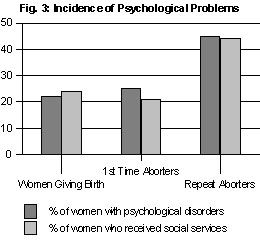
For example, a study published in the Journal of Psychosomatic Obstetrics and Gynecology found that while there was no significant difference in psychological disorders or use of social services between women carrying to term and those seeking abortion for the first time, women who had already had an abortion were almost twice as likely to have psychological disorders or to have had contact with the social service system (see table at right).[1]

Past research also suggests that repeat abortion may be both a result and a trigger of emotional and psychological problems. For example, women who had repeat abortions were found to be more likely to abuse drugs or alcohol, to be living in unstable situations, to be divorced or be dependent on social services. These are all factors that can lead to additional abortions: women with a prior abortion experience are four times more likely to abort a current pregnancy than those with no prior abortion history.[2]

This increased risk is associated with the prior abortion due to lowered self esteem, a conscious or unconscious desire for a replacement pregnancy, and increased sexual activity post-abortion. Subsequent abortions may occur because of conflicted desires to become pregnant and have a child and continued pressures to abort, such as abandonment by one’s partner. Aspects of self-punishment through repeated abortions are also reported. [3]
___
 
Learn more: Read a therapist’s perspective on repeat abortions.

Access the world’s most extensive online library of studies on the physical and psychological effects of abortion at www.AbortionRisks.org.

Citations
1. Tornbom, M., et. al., “Repeat Abortion: A Comparative Study,” Journal of Psychosomatic Obstetrics and Gynecology, 17:208-214, 1996.
2. Joyce, “The Social and Economic Correlates of Pregnancy Resolution Among Adolescents in New York by Race and Ethnicity: A Multivariate Analysis,” Am. J. of Public Health, 78(6):626-631 (1988); C. Tietze, “Repeat Abortions – Why More?” Family Planning Perspectives 10(5):286-288, (1978).
3. Leach, “The Repeat Abortion Patient,” Family Planning Perspectives, 9(1):37-39 (1977); S. Fischer, “Reflection on Repeated Abortions: The meanings and motivations,” Journal of Social Work Practice 2(2):70-87 (1986); B. Howe, et al., “Repeat Abortion, Blaming the Victims,” Am. J. of Public Health, 69(12):1242-1246, (1979).