Mostrar mensagens com a etiqueta mortalidade materna. Mostrar todas as mensagens

sexta-feira, 8 de março de 2013

Aborto aumenta mortalidad materna y daña salud de mujeres, aseguran expertos ante ONU

NUEVA YORK, 08 Mar. 13 / 04:39 am (ACI/EWTN Noticias).- Expertos en medicina argumentaron en Nueva York ante la Comisión Jurídica y Social de la Mujer de la Organización de las Naciones Unidas (ONU), que el aborto incrementa la tasa de mortalidad materna y daña la salud de las mujeres.

Los especialistas, provenientes de diversas partes del mundo, afirmaron que el aborto no es necesario para promover la salud de las mujeres ya que en realidad la perjudica.


Además rechazaron las hipótesis de los que apoyan la expansión del aborto como “derecho”, enfatizando que en los embarazos, incluso aquellos considerados como de alto riesgo, no generan un conflicto entre las necesidades de la madre y las del niño.


La Dra. Donna J. Harrison, Directora de Investigación de la Póliza Pública de la Asociación Estadounidense de Obstetras y Ginecólogas Provida, conversó con ACI Prensa luego de su intervención ante la ONU el 6 de marzo.


Harrison enfatizó que “los verdaderos cuidados médicos disminuyen la tasa de mortalidad materna, el aborto en cambio no” y señaló que las píldoras abortivas originan “una alza en las complicaciones después del aborto. Son mucho más peligrosas”.
 

La experta recordó que para los que promueven el aborto "es mucho más fácil promover una píldora que el aborto quirúrgico” porque para los que realizan esta práctica es “más barato dársela a una mujer, que cuidar de ella quirúrgicamente o estar disponible para ella en caso se presentara alguna complicación".
 

Señaló asimismo que las píldoras, al no estar necesariamente bajo la supervisión de un médico, se administran libremente y sin haber examinado a la mujer “y sin ningún plan de seguimiento". Todo eso es lo que en realidad aumenta el riesgo de mortalidad.
 

La doctora subrayó que en países en vía de desarrollo, si se presentan complicaciones como hemorragia severa y abortos incompletos, “se convierten en muerte” porque la mujer no tiene la posibilidad de acceder a una atención de emergencia inmediata.
 

Otro de los especialistas que intervino ante la Comisión fue el Dr. Eoghan De Faoite, miembro de la Junta de la Comisión de Excelencia en la Salud Materna de Irlanda.
 

El médico criticó los ataques internacionales a la defensa de la vida a través de la prohibición del aborto en Irlanda y precisó que esta práctica no es un procedimiento médicamente necesario.
 

De Faoite dijo que Irlanda tiene una de las tasas más bajas de mortalidad materna en el primer mundo y que no han experimentado el "aumento de la mortalidad" que se ve en otros países occidentales que han legalizado el aborto.
 

Además citó varios estudios que afirman que no hay datos que sugieran que el aborto disminuye la mortalidad materna.
El Dr. Elard Koch del Centro de Medicina Embrionaria y la Salud Materna en Chile explicó a su turno que los datos que demuestran un aumento de la mortalidad materna cuando se ha legalizado el aborto en diversos países alrededor del orbe.

Koch sostuvo que la mortalidad materna se puede reducir con la educación, teniendo más técnicos especializados en la atención de partos.

Precisó que una de las medidas que debe promoverse es que las mujeres tengan acceso a centros higiénicos de salud con un personal altamente calificado, en vez del aborto como alternativa que solo daña a las mujeres.

quinta-feira, 29 de novembro de 2012

Repeat Abortions: What the Research Says

In AfterAbortion

According to the Alan Guttmacher Institute, approximately 45 percent of abortions are repeat abortions. Two new studies released last month have found increased risks for women who undergo multiple abortions.
 
One study, co-authored by Elliot Institute director Dr. David Reardon, found that women who undergo abortions have an increased risk of death:

A single induced abortion increases the risk of maternal death by 45 percent compared to women with no history of abortion, according to a new study of all women of reproductive age in Denmark over a 25 year period.

In addition, each additional abortion is associated with an even higher death rate. Women who had two abortions were 114 percent more likely to die during the period examined, and women had three or more abortions had a 192 percent increased risk of death. …
“We knew from our previous studies of low income women in California that women who have multiple pregnancy outcomes, such as having a history of both abortion and miscarriage, have significantly different mortality rates,” Reardon said. “But this new study is the first to examine how each experience with abortion or miscarriage contributes to higher mortality rates.”

This is called a “dose effect” because “each exposure, or ‘dose,’ is seen to produce more of the same effect, which is what one would expect if there is a cause-effect relationship,” Reardon explained.
The other new study found that women who undergo multiple abortions have an increased risk of preterm birth and low-birthweight babies in a subsequent pregnancy :

The study, printed in the peer-reviewed medical journal Human Reproduction, of more than 300,000 women found women who have three or more abortions face a 35 percent increase in health complications in a future pregnancy and also saw an increase in the risk of a baby’s death around the time of birth.Having just one abortion or more increased the likelihood of giving birth before reaching 37 weeks of pregnancy.

“To put these risks into perspective, for every 1,000 women, three who have had no abortion will have a baby born under 28 weeks,” Dr Reija Klemetti, who led the study, told the Scotsman newspaper. “This rises to four women among those who have had one abortion, six women who have had two abortions, and 11 women who have had three or more.”
These two new studies follow a Chinese study, published in February of 2012, that found a “very statistically significant increased risk” of breast cancer for women with previous abortions, which increased for women with multiple abortions.

Past studies have also found an increased risk of psychological and physical problems related to multiple abortions.

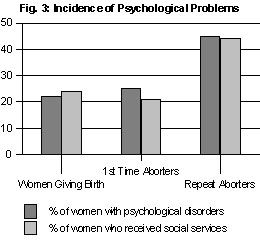
For example, a study published in the Journal of Psychosomatic Obstetrics and Gynecology found that while there was no significant difference in psychological disorders or use of social services between women carrying to term and those seeking abortion for the first time, women who had already had an abortion were almost twice as likely to have psychological disorders or to have had contact with the social service system (see table at right).[1]

Past research also suggests that repeat abortion may be both a result and a trigger of emotional and psychological problems. For example, women who had repeat abortions were found to be more likely to abuse drugs or alcohol, to be living in unstable situations, to be divorced or be dependent on social services. These are all factors that can lead to additional abortions: women with a prior abortion experience are four times more likely to abort a current pregnancy than those with no prior abortion history.[2]

This increased risk is associated with the prior abortion due to lowered self esteem, a conscious or unconscious desire for a replacement pregnancy, and increased sexual activity post-abortion. Subsequent abortions may occur because of conflicted desires to become pregnant and have a child and continued pressures to abort, such as abandonment by one’s partner. Aspects of self-punishment through repeated abortions are also reported. [3]
___
 
Learn more: Read a therapist’s perspective on repeat abortions.

Access the world’s most extensive online library of studies on the physical and psychological effects of abortion at www.AbortionRisks.org.

Citations
1. Tornbom, M., et. al., “Repeat Abortion: A Comparative Study,” Journal of Psychosomatic Obstetrics and Gynecology, 17:208-214, 1996.
2. Joyce, “The Social and Economic Correlates of Pregnancy Resolution Among Adolescents in New York by Race and Ethnicity: A Multivariate Analysis,” Am. J. of Public Health, 78(6):626-631 (1988); C. Tietze, “Repeat Abortions – Why More?” Family Planning Perspectives 10(5):286-288, (1978).
3. Leach, “The Repeat Abortion Patient,” Family Planning Perspectives, 9(1):37-39 (1977); S. Fischer, “Reflection on Repeated Abortions: The meanings and motivations,” Journal of Social Work Practice 2(2):70-87 (1986); B. Howe, et al., “Repeat Abortion, Blaming the Victims,” Am. J. of Public Health, 69(12):1242-1246, (1979).


domingo, 9 de setembro de 2012

Risk of death increases after abortion: Danish study - by Hilary White

ROME, September 6, 2012, (LifeSiteNews.com) – While the abortion industry continues to say that abortion is safer than natural childbirth, more research is finding that abortion significantly increases the risk of maternal death. A new study of 463,473 women from Denmark over a 30-year period shows that the risk of death following a first trimester abortion is significantly increased compared to women delivering a first pregnancy. The heightened risk ranges from 84 percent after 180 days to 39 percent after 10 years.

The risk is considerably higher for abortions after 12 weeks gestation, from 331 percent after one year to 141 percent after a decade.


Death rates associated with natural childbirth were lower than those associated with all three types of pregnancy loss in every year. The study showed a significantly higher rate of death associated with later abortions than for natural birth for every time period over one year. 
 
(Click “like” if you want to end abortion! )

The rate of death compared with miscarriage was not higher than that for birth, except in the 10-year range.

The research was conducted by David C. Reardon and Priscilla K. Coleman of the Elliot Institute and the Human Development and Family Studies department of Bowling Green State University in Ohio. 
 
The academics looked at medical and death records for the entire female population of Denmark born between 1962 and 1991 and who were alive in 1980. They did not consider specific causes of death. The authors wrote that they were particularly interested in seeing the rates of death associated with early abortions, for which there is very little solid data.

They said that previous population studies on the long term effects of abortion have failed to take into account “complete reproductive histories” of their subjects. Reardon and Coleman’s research corrected this by eliminating multiple births, examining only first pregnancy rates of singleton pregnancies. It examined death rate outcomes per 100,000 population after both early and late abortions, those after 12 weeks gestation.

Their numbers comes from Statistics Denmark: the National Hospital Register, the Fertility database for births and stillbirths, the National Board of Health Abortion Registry for abortions and the Cause of Death Register for 1977 to 2004.

The study closely follows recently released data from Finland, published in the journal Human Reproduction, showing statistically significant links between abortion and low birth weight and prematurity in subsequent births.

quarta-feira, 18 de julho de 2012

Here’s Twenty Bucks: Don’t Have Babies - by Greg Pfundstein and Meghan Grizzle

 
Melinda Gates and the Family Planning Summit will waste 4.6 billion dollars on contraception for women in third world countries instead of addressing the educational and healthcare-related challenges pregnant mothers face.

A June 26 press release from Save the Children, an international humanitarian organization, begins ominously: “Pregnancy is the biggest killer of teenage girls worldwide, with one million dying or suffering serious injury, infection or disease due to pregnancy or childbirth every year.”

One million is a big number, and a friend who sent the press release insisted that his jaw dropped when he read that, in his words, “teen pregnancy is responsible for over 1 million deaths a year in the developing world.”

There is a subtle, but important, discrepancy here. The report says one million teenage girls die or suffer serious injury, infection or disease due to pregnancy, the operative word being the conjunction. What our friend read was that one million teenage girls die annually due to pregnancy, full stop. When we read the email, before reading the press release, we were confused. According to the World Health Organization, in 2010, 287,000 women died of pregnancy-related causes. Could Save the Children be so brazen as to claim that the number of teenagers dying in childbirth was nearly three and a half times the total number of pregnancy-related deaths worldwide? We were intrigued.

It turns out that the actual report, Every Woman’s Right: How family planning saves children’s lives, states that only 50,000 women ages 15 to 19 die every year of pregnancy-related causes. Now that’s different. Although this figure is terribly tragic, it represents only 5% of the one million that the press release implies in its first line, “biggest killer…, with one million.” Our friend can be excused for misunderstanding.

The Save the Children report was released as part of an effort to draw attention to the Family Planning Summit organized by Melinda Gates in London this month, which has now concluded with an enormous amount of money—some $4.6 billion—secured to meet the supposedly unmet need for contraception. The blustery rhetoric with which Save the Children and other groups worked to prime the pump for the Summit is a sure sign that we should be wary of the claim of nearly universal consensus that more funding for contraception in the Third World is the answer to the maternal mortality problem.

So do we need more money for family planning? USAID has budgeted fully $547 million for family planning in 2012, and the Gates Foundation spent $437 million in 2009. With EU nations included, we are easily over one billion dollars in family planning funds annually. That’s a lot of money. We need more? Every dollar spent on family planning is a dollar not spent on other urgent needs, like education, basic health care, and infrastructure.

There is no question that it is a travesty when anyone dies of a pregnancy-related cause, and it is particularly tragic when adolescents do. But the vast majority of these maternal deaths are preventable. Let’s look at how $4.6 billion could be used to reduce maternal mortality.

First, the provision of skilled birth attendants is particularly critical to combat maternal mortality. According to UNFPA, providing skilled birth attendants to all women would reduce maternal mortality by 75 percent.  Skilled attendance at birth has been shown to correlate with lower maternal mortality ratios. A survey of 58 countries where 91 percent of maternal deaths occur shows that less than 17 percent of the world’s midwives are available in those countries. The provision of midwives worked in Sweden in the 1800s, and it has worked recently in countries such as Sri Lanka, Malaysia, Thailand, and Egypt. A large scale birth attendant training program would be a straightforward, highly measurable, and long lasting intervention that would significantly decrease the maternal mortality ratio. Gates’s $4.6 billion will not be spent on such a program.

In addition, access to education should be a major concern in efforts to decrease teenage pregnancy and the maternal mortality ratio. More educated women delay and space their pregnancies, which allows them to maintain their health, and education empowers women to determine for themselves how best to control their fertility.

The educational level of women is also highly correlated to the maternal mortality ratio. The education a woman has represents both the opportunities she has had and the opportunities she will have in the future; it also “promotes increasing autonomy, awareness, responsibility and knowledge for self-care, healthy lifestyles and behaviours.” An educated woman therefore will access the appropriate maternal and reproductive health services, including skilled birth attendants, greatly reducing her likelihood of maternal death. This affirms the central role of education in combating maternal mortality. Also, because women’s educational attainment means access to information about appropriate prenatal and postnatal care and childbirth, it follows that the maternal mortality ratio can decrease in areas where women typically do not have a high educational attainment, so long as they are provided with information about best practices related to their pregnancies. Gates’s $4.6 billion will not be spent on primary and secondary education for girls, either.

Adolescent girls and women also need access to basic and maternal health care. When governments focus intensively on maternal and child health, introducing health measures such as low-cost basic health care, including prenatal, postnatal, and obstetric health care, and social protection for the extreme poor, the maternal mortality ratio decreases drastically. 4.6 billion dollars could also help improve the poor medical infrastructures in countries with the highest maternal mortality ratios.

The push for contraception as a solution to maternal mortality is also problematic because many women won’t use it. The claim that 222 million women lack access to contraception is misleading. First, it is not necessarily a matter of access. Many women have access to contraception and choose not to use it. Social scientists and public policy experts identify women as having an unmet need for contraception even when those women have not expressed a desire to use contraception. The idea of unmet need for contraception ignores the reasons for unmet need that women express, such as concern about health and other side effects of artificial contraception, and incompatibility with religious and ethical beliefs. The fact that a woman is not using contraception is not the same as an unmet need for contraception. The more relevant datum would be the number of women who want contraception and cannot get it. That number is much less than 222 million. Another helpful figure would be the number of women who do not want to use contraception and do not have access to other methods of family planning, such as knowledge-based fertility education programs.

But even if we assume that it is true that 222 million women want contraception and can’t get it, do we really need $4.6 billion more in funding for contraception? That’s twenty dollars for each woman. A woman whose education has not been improved; whose access to essential healthcare has not been improved; whose very real and legitimate desire for children has not been met; whose economic opportunities have not been improved a whit. For this woman, Melinda Gates has one message: “Here’s twenty bucks; don’t have babies.”

Even worse, the promise of more aid from the Gates Foundation incentivizes local government officials and family planning authorities to start pushing contraception on women even if they don’t want to use it. This can lead to undue influence or coercion, eerily reminiscent of the population control movement.

There is no question that there are vastly different ideas of the value of human life at work here. The folks at Save the Children and their friends at the Gates Foundation think human persons are better off never existing than being born into poverty and dying before reaching their full potential. There are also very different ideas of how population relates to economic development that are quite germane to this controversy. Let that be. As a practical matter, it seems unlikely that Gates and friends will be able to have substantially greater success than decades of similar effort have had. It is a tragedy that they won’t spend their enormous resources trying to empower women who want to bring children into this world to do so safely and with the support of the medical resources they need.

Those of us who value all human life, from conception to natural death, should regret this terrible misallocation of resources, but we should also work to defend and protect, and indeed empower, those women whom Melinda Gates wishes to subject to her idea that contraception is their single most important unmet need. Let’s not forget that this idea is the same idea that underlies the population control movement, which has promoted contraception for decades in an attempt to reduce the population. The Family Planning Summit, which coincided with World Population Day, may not have used this rhetoric, but the simple fact is that women and men ultimately want to bring children into the world. Not all the contraception on earth will change that. Rather than try to prevent them from doing so, we should work to ensure they can do so safely.


Greg Pfundstein is the Executive Director of the Chiaroscuro Foundation. Meghan Grizzle is the Research and Policy Specialist at the World Youth Alliance.

terça-feira, 17 de julho de 2012

Elard Koch demuestra con datos que el aborto aumenta la mortalidad materna

In InfoCatólica

La legalización del aborto aumenta la mortalidad materna, asegura el director de Investigación del Departamento de Salud de la Universidad de Chile, Elard Koch. En su visita a Puebla, explicó que muchos de los países en Iberoamérica son presionados para la legalización del aborto y aseguró que en el estado de México, donde es legal la práctica, aumentó en 15 por ciento la mortalidad materna.

(E-consulta) Señaló que en Chile, tras la prohibición de todo tipo de aborto junto con el incremento a la educación a la mujer y la implementación de políticas públicas, la tasa de mortalidad materna disminuyó desde 41.3 hasta 12.7 muertes por cada 100 mil nacimientos vivos.

El médico chileno agregó que durante los últimos 75 años México ha logrado reducir la mortalidad materna de manera significativa, con una cifra de 37 decesos por cada 100 mil alumbramientos, lo que lo coloca en el contexto mundial en el séptimo lugar en este sentido.

Ante ello, recomendó a las autoridades comparar la situación que se vive en cada región respecto al tema del aborto, pues la evidencia científica demuestra que las naciones que, como Inglaterra, Suiza y España, lo han legalizado han reflejado un aumento en sus índices de mortalidad materna.

El investigador en epidemiología molecular destacó que el factor más importante para reducir la mortalidad materna es el incremento de la educación de la mujer.

Al finalizar señaló que las leyes a favor del derecho a la vida provocan que muchas mujeres que consideran el aborto como una opción, desistan del mismo y lleven su embarazo a término.

segunda-feira, 28 de fevereiro de 2011

Chile demuestra que aborto no reduce mortalidad materna


NUEVA YORK, 28 Feb. 11 / 03:28 am (ACI)

Chile recibió el premio International Protect Life Award (a la protección internacional de la vida) por ser el país con la tasa más baja de mortalidad materna en América Latina, con lo que demuestra que el aborto -a diferencia de lo que dicen sus promotores- no contribuye en nada a disminuir el número de muertes entre las madres ya que esta práctica es ilegal en esta nación sudamericana.

Cerca de 30 representantes de organizaciones pro-vida que trabajan ante la Organización de Naciones Unidas (ONU) otorgaron el galardón en el marco de la 55° sesión de la Comisión de la Condición Jurídica y Social de la Mujer (CSW 2011) que se realiza en Nueva York entre el 22 de Febrero y el 4 de Marzo.

En declaraciones a ACI Prensa el 25 de febrero, el vocero de los líderes pro-vida, Dan Zeidler, señaló que "hay que destacar que Chile no tiene legalizado el aborto en ningún caso. Chile respeta la vida tanto de la mujer como del niño, los dos son iguales ante la ley".

"Me parece que ese sistema jurídico hay que felicitarlo y reconocer que lo que dicen mucho los abortistas de que hay que legalizar el aborto para bajar la mortalidad materna no es cierto, inclusive es todo lo contrario", agregó.

Zeidler también se refirió a la carta enviada por los líderes pro-vida al presidente de Chile a raíz de este premio y explicó que en ella animan y exhortan al mandatario a proseguir con dos programas importantes para la defensa de la vida de los niños y las madres en el país: "Chile crece contigo" y "Comprometidos con la vida".

El primero de ellos, dijo el vocero a ACI Prensa, "es un ejemplo maravilloso de lo que un país y un gobierno pueden hacer para promover de una manera muy sensible y buena el valor de la vida humana en sus programas".

La iniciativa promueve la salud de niño entre 0 y 5 años, incluidos los que están por nacer. "El programa -explicó- ayuda a los padres a entender que su guagua (niño) merece mucha atención y cuidado antes y después de nacer".

"No es un programa nuevo sino que tiene algunos años y fue lanzado en el gobierno de Michelle Bachelet. Es interesante saber que no es un programa solo de un gobierno o una sola ideología en Chile", añadió.

El segundo programa fue establecido en el gobierno de Sebastián Piñera y busca ayudar a madres embarazadas en situaciones difíciles.

Tras explicar que Chile como estado ha expresado en diversas oportunidades su posición pro-vida en el debate internacional como en Brasil y Suiza en 2010, Dan Zeidler dijo que "hay que reconocer lo bueno y muchos chilenos incluso no se han dado cuenta de la riqueza que tienen".

"A nivel internacional es necesario destacar este buen ejemplo de Chile para los demás países", concluyó.

Por su parte, Julia Cardenal de El Salvador, una de las firmantes de la carta enviada al presidente Piñera, señaló sobre el premio a Chile que "mejorar la salud materna respetando toda vida humana es la clave para todos los países que deseen realmente llegar a reducir la mortalidad materna en cumplimiento del Objetivo de Desarrollo del Milenio".

Los números

Una investigación del Dr. Elard Koch de la Facultad de Medicina de la Universidad de Chile comparando datos entre 1957 y 2008 sobre la mortalidad materna por aborto muestra que ésta se redujo en 97,6 por ciento en estos 51 años.

Tras la prohibición del aborto terapéutico en 1989, se redujo de 13,62 a 1,65 por cada 100 000 nacidos vivos, es decir, un 87,9 por ciento.

Actualmente, explica Koch, el riesgo actual que tiene una madre de morir a causa del aborto es de 0,09 por 100 000.

Estos resultados, explica el experto, muestran que una legislación que protege la vida del niño por nacer no incrementa la mortalidad materna ni los abortos ilegales; y que legalizar o despenalizar el aborto provoca una "epidemia" abortista con graves consecuencias para la salud de las mujeres y para el país.

Koch, cuyo estudio fue presentado en enero de 2010 en la reunión inaugural del International Working Group for Global Women's Health Research, en Washington D.C. (Estados Unidos), precisa además que el camino que ha permitido disminuir la mortalidad materna ha sido la promoción de "embarazos seguros" y no el aborto.

sexta-feira, 16 de abril de 2010

Statistics from Brazil itself indicate a level of maternal mortality for girls ages 10-14 that is much lower than that of the general population

192,445 girls from 10 to 14 years old gave birth between 2000 and 2006 in Brazil

Although pro-abortion organizations and doctors often claim that pregnancies at an early age threaten the life of the mother, statistics from Brazil itself indicate a level of maternal mortality for girls ages 10-14 that is much lower than that of the general population.

Investigative report By Matthew Cullinan Hoffman, Latin America Correspondent
See Part I at http://www.lifesitenews.com/ldn/2009/mar/09032018.html

RECIFE, BRAZIL, March 24, 2009 (LifeSiteNews.com) - After learning that hospital staff at the Institute of Children's Medicine of Pernambuco (IMIP) were seeking to manipulate the parents of a pregnant nine year old to approve an abortion for their child, Fr. Edson Rodrigues says that officials at the IMIP sought to deny all access to the parents and child by the tutelary counselors (representatives of the local child protective services) and to Fr. Rodrigues himself.

However, following the father's exit from the facility, Fr. Rodrigues says that he and the two tutelary counselors were able to talk to him. The father, Erivaldo Francisco, said that he had been convinced of the necessity of an abortion by a social assistant named Karolina Rodrigues, a woman with no medical expertise. Despite headlines in the local newspaper claiming that he and the girl's mother were being guided by a team of medical experts at the hospital, he acknowledged that he had not spoken to a single doctor.

But what Francisco had been told was false. In fact, as the IMIP would later admit publicly, his daughter was in no danger at the time the abortion took place. Moreover, Brazil's own statistics reveal that pregnancies for girls 14 and under have a lower mortality rate than women as a whole.

According to statistics provided by the pro-abortion Grupo Curumim and derived from the Brazilian government's DATASUS/MS service, 192,445 girls from 10 to 14 years old gave birth between 2000 and 2006 in Brazil, while 105 died during pregnancy, birth, or having an abortion, that is, 55 out of 100,000 (http://grupocurumim.blogspot.com/2009/03/coletiva-sobre-caso-da-menina-de.html). Even if one were to assume that none of the deaths were caused by induced abortions, an unlikely assumption, this mortality rate is lower than the average maternal mortality rate for all ages in Brazil, which is 75 out of 100,000 (see http://tabnet.datasus.gov.br/cgi/idb2007/c03.htm).

The rate may be lower because such cases, being relatively uncommon, receive special attention in Brazil. Hospitals monitor such pregnancies closely, and a cesarean section can be done to protect the child from the rigors of giving birth.

Dr. Elizabeth Kipman Cerqueira, a Brazilian obstetrician, said in a public statement on the case that "I don't know anyone who died because of the young age at which she was impregnated, if she received adequate accompaniment," and that she personally knows of cases of 10 year olds who gave birth and are in good health. She added that the abortion is likely to do serious damage to the girl psychologically, and noted that early labor could have been induced at some point after 22 weeks, rather than an abortion. The twins were already at over 20 week's gestation when they were killed.

Ironically, at the same time that the IMIP staff was seeking an abortion for their young Brazilian patient, a nine year old girl in Peru was giving birth successfully, becoming the youngest mother in Peru. She had been sexually abused by a relative, and would be receiving counseling and financial assistance from the Peruvian government, the AP reported (see article in Portuguese at http://noticias.uol.com.br/ultnot/afp/2006/12/02/ult34u169397.jhtm).

However, despite the lack of danger to the mother, pro-abortion physicians at the highest levels of the hospital were conspiring to bring about the death of her unborn twins. Vilma Guimares, the coordinator of IMIP's Center for Attention for Women, was publicly advocating an abortion as early as February 27, even though she admitted that she had never examined the girl. "In situations of pregnancies that carry risks for the mother it is better to interrupt the pregnancy," she told the Diario de Pernambuco newspaper. Based on such a standard, abortions could be justified in all pregnancies, because pregnancy always carries some degree of risk.

Fr. Rodigues notes that Vilma Guimares was one of only two people who had access to the mother and her daughter at IMIP, the other being the hospital's director, Antonio Figueiras. It is unknown if Guimares induced the child's mother to give consent to the abortion.

Following the events at the IMIP, Rodrigues and the tutelary counselors contacted Bishop Francisco Biasin of Pesqueira, the diocese in which the child resided, and explained the situation. Biasin in turn contacted Archbishop Jose Cardoso Sobrinho of the Archdiocese of Olinda and Recife, where the IMIP was located. The two began to confer with attorneys and doctors to determine what they could do to save the unborn twins living inside the girl. During the period in which the controversy raged Archbishop Cardoso says he was working 15 hours a day on the case.

Cardoso held a meeting on the morning of March 3rd in the episcopal residence, attended by the director of the IMIP, Antonio Figueiras. After being informed of the manipulative behavior of hospital staff, Figueiras agreed to cancel plans to carry out an abortion on the twins at his facility.

In addition, the Archdiocese of Olinda and Recife began legal proceedings to stop the abortion. On the afternoon of March 3, Figueiras and Erivaldo both appeared before the Tribunal of Justice of the State of Pernambuco, and the presiding judge reportedly expressed his desire to prevent the abortions from occurring. Erivaldo Francisco became convinced that he had made a mistake in consenting to the abortion, and signed a statement withdrawing permission for the procedure, which he delivered to the hospital. The hospital publicly acknowledged to the O Globo newspaper that permission to carry out the procedure had been withdrawn by Francisco.

However, in the interim, Archbishop Cardoso had received a call from Figueiras, Rodrigues reports. Members of a pro-abortion feminist organization, Grupo Curumim, had entered the hospital with two technicians from the Secretary of Health of the State of Pernambuco, and had convinced the mother to sign her daughter out of the hospital. Rodrigues says he was told that she then left, accompanied by the pro-abortion Vilma Guimares. The hospital would claim that it did not know where they had gone, and had no means of contacting Guimares.

Grupo Curumim, which agitates for the legalization of abortion in Brazil, is an organization funded by the international pro-abortion lobby, notes Alberto Monteiro, a prominent Brazilian pro-life activist.

"Grupo Curumim affirms that it is an organization whose work is financed by the IWHC, or International Woman's Health Coalition...the IWHC is a feminist entity and one of the biggest international promoters of clandestine abortions," writes Monteiro in an open email on the case. "The entity was practically funded by Adrianne German, a sociologist who before having founded the IWHC had worked for the Population Council of New York, one of the Rockefeller organizations that developed, in the 1950s, all of the work on population control and the promotion of abortion which we see today at the international level without knowing where these things come from. "

When asked by the newspaper O Globo about releasing the girl from the hospital, the newspaper reports that "the hospital argues that it was obligated to let her go, given that the child did not run the risk of death and that is the right of the child's guardian," thus admitting publicly that the child was not, in fact, in danger of death (see original article in Portuguese at http://oglobo.globo.com/pais/cidades/mat/2009/03/04/igreja-catolica-tenta-impedi...).

Arriving at the hospital with Francisco and a physician and psychologist sent by the Archdiocese, Rodrigues reports that after being made to wait, they were told that the child had been removed by her mother, and no one knew where they had gone. Rodrigues held a press conference denouncing the transfer.

The next day, March 4, the press revealed that the child had been taken to the Amaury de Medeiros Integral Health Center (Centro Integrado de Saúde Amaury de Medeiros, or CISAM) of the University of Pernambuco. There, the openly pro-abortion medical staff had aborted the twins.

Dr. Rivaldo Mendes de Albuquerque, who performed the abortions, stated openly that the case "showed that the question of abortion is a matter of public health in Brazil, and must be considered case-by-case. Restrictive laws do not improve public health, particularly women's health," in an interview with the BBC.

He also claimed in the same interview that "the religious laws were written by the clerics, and do not translate God's words exactly. That gave us peace of mind, and we recognized that the Catholic Church has made, and continues to make, mistakes, and especially with regard to women's rights in Brazil and the rest of the world. The Church is meddling inappropriately into these rights, which are internationally recognized human rights."

See Part III at http://www.lifesitenews.com/ldn/2009/mar/09032514.html