In AfterAbortion
According to the Alan Guttmacher Institute, approximately 45 percent
of abortions are repeat abortions. Two new studies released last month
have found increased risks for women who undergo multiple abortions.
One study,
co-authored by Elliot Institute director Dr. David Reardon, found that
women who undergo abortions have an increased risk of death:
A single induced abortion increases the risk of maternal
death by 45 percent compared to women with no history of abortion,
according to a new study of all women of reproductive age in Denmark over a 25 year period.
In addition, each additional abortion is associated with an even
higher death rate. Women who had two abortions were 114 percent more
likely to die during the period examined, and women had three or more
abortions had a 192 percent increased risk of death. …
“We knew from our previous studies of low income women in California that
women who have multiple pregnancy outcomes, such as having a history of
both abortion and miscarriage, have significantly different mortality
rates,” Reardon said. “But this new study is the first to examine how
each experience with abortion or miscarriage contributes to higher
mortality rates.”
This is called a “dose effect” because “each exposure, or ‘dose,’ is
seen to produce more of the same effect, which is what one would expect
if there is a cause-effect relationship,” Reardon explained.
The study, printed in the peer-reviewed medical journal
Human Reproduction, of more than 300,000 women found women who have
three or more abortions face a 35 percent increase in health
complications in a future pregnancy and also saw an increase in the risk
of a baby’s death around the time of birth.Having just one abortion or
more increased the likelihood of giving birth before reaching 37 weeks
of pregnancy.
“To put these risks into perspective, for every 1,000 women, three
who have had no abortion will have a baby born under 28 weeks,” Dr Reija
Klemetti, who led the study, told the Scotsman newspaper. “This rises
to four women among those who have had one abortion, six women who have
had two abortions, and 11 women who have had three or more.”
These two new studies follow a Chinese study, published in February of 2012, that found a “very statistically significant increased risk” of breast cancer for women with previous abortions, which increased for women with multiple abortions.
Past studies have also found an increased risk of psychological and physical problems related to multiple abortions.
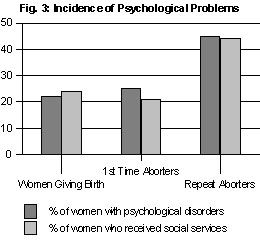
For example, a study published in the Journal of Psychosomatic Obstetrics and Gynecology
found that while there was no significant difference in psychological
disorders or use of social services between women carrying to term and
those seeking abortion for the first time, women who had already had an
abortion were almost twice as likely to have psychological disorders or
to have had contact with the social service system (see table at
right).[1]
Past research also suggests that repeat abortion may be both a result
and a trigger of emotional and psychological problems. For example,
women who had repeat abortions were found to be more likely
to abuse drugs or alcohol, to be living in unstable situations, to be
divorced or be dependent on social services. These are all factors that
can lead to additional abortions: women with a prior abortion experience
are four times more likely to abort a current pregnancy than those with
no prior abortion history.[2]
This increased risk is associated with the prior abortion due to
lowered self esteem, a conscious or unconscious desire for a replacement
pregnancy, and increased sexual activity post-abortion. Subsequent
abortions may occur because of conflicted desires to become pregnant and
have a child and continued pressures to abort, such as abandonment by
one’s partner. Aspects of self-punishment through repeated abortions are
also reported. [3]
___
Learn more: Read a therapist’s perspective on repeat abortions.
Access the world’s most extensive online library of studies on the physical and psychological effects of abortion at www.AbortionRisks.org.
Citations
1. Tornbom, M., et. al., “Repeat Abortion: A Comparative Study,” Journal of Psychosomatic Obstetrics and Gynecology, 17:208-214, 1996.
2. Joyce, “The Social and Economic Correlates of Pregnancy Resolution
Among Adolescents in New York by Race and Ethnicity: A Multivariate
Analysis,” Am. J. of Public Health, 78(6):626-631 (1988); C. Tietze,
“Repeat Abortions – Why More?” Family Planning Perspectives
10(5):286-288, (1978).
3. Leach, “The Repeat Abortion Patient,” Family Planning
Perspectives, 9(1):37-39 (1977); S. Fischer, “Reflection on Repeated
Abortions: The meanings and motivations,” Journal of Social Work
Practice 2(2):70-87 (1986); B. Howe, et al., “Repeat Abortion, Blaming
the Victims,” Am. J. of Public Health, 69(12):1242-1246, (1979).