Mostrar mensagens com a etiqueta Abusos de menores. Mostrar todas as mensagens

terça-feira, 11 de fevereiro de 2014

Spiritual Healing After Sexual Abuse - Dawn Eden interview by John Burger

 In CWR

Dawn Eden sees herself as a missionary. Herself a victim of sexual abuse as a child, abuse that was healed in part through her journey of faith, she now envisions bringing God's healing to other victims, particularly those who are underserved, such as prisoners. 
Eden, a Catholic convert who grew up Jewish, weaves her story of abuse with those of saints who suffered abuse of various kinds. In My Peace I Give You: Healing Sexual Wounds with the Help of the Saints, she offers advice on how victims can heal through learning some of those stories, through prayer, and through forgiveness. 
In an interview with Catholic World Report, the author of the 2006 best-seller The Thrill of the Chaste offers suggestions on how the Church can reach out more effectively to victims of abuse, whether that abuse took place in the Church or in the victim’s very own home. 

CWR: What led you to write this book?
Dawn Eden: I myself am a victim of childhood sexual abuse. For me, when I received the grace of faith in Christ at the age of 31, I was instantly healed of the depression and temptations to suicide that had dogged me since my teens and which I later learned were the effects of post-traumatic stress disorder brought on by the abuse. But what I discovered during my first years as a Christian, during which I was a Protestant, was that although I had experienced this dramatic healing from the worst aftereffects of the abuse, I still had other effects to contend with, including anxiety, flashbacks, and hyper-sensitivity. And my thought as a new Christian was that the fact that I had not yet received healing from these effects meant that I wasn’t fully surrendered, that I didn’t have enough faith. So I blamed myself for my own seeming failure to be living completely within the light of the risen Christ.
Five years after becoming a Christian I made the decision to become Catholic, and I was received into the Church in 2006, at the age of 37. Once I was a Catholic I knew there was nowhere else to go; I was home. And I also instinctively felt from what I understood of the Catholic faith that somehow the wounds I retained from the abuse, these effects had some kind of meaning in Christ, that they weren’t my fault. But I struggled to understand what meaning these wounds might have.
Two things happened in 2010 that led me to a new and deeper healing. The first was an experience I had on an Ignatian retreat, where for the first time I really began to see my own wounds in light of the wounds of Christ. And I realized, with Christ now being glorified and yet retaining his wounds, that if I united my own wounded heart to the wounded and glorified heart of Jesus, then somehow my wounds could become the crack that Christ’s light could get in. This was a revelation for me because all this time I’d been thinking that my wounds separated me from the love of Christ, that they were simply an obstacle. But this insight made me realize that in fact I could actually find healing in Christ not in spite of my wounds but through my wounds. My wounds could lead me to greater intimacy with God through realizing my dependence upon him for everything, and through personally participating in the victory over sin that Jesus won for me through his passion.
The second insight I received in 2010 was when I picked up a book called Modern Saints by Ann Ball, and that’s where I discovered the story of Blessed Laura Vicuña. Ann Ball describes Bl. Laura, as many people do, as another Maria Goretti. Certainly her story is very similar in that she died while still quite young, in the early 20th century. And she died following being brutalized by a man who sought to sexually victimize her. But in reading Bl. Laura’s story, I noticed a difference in that while Maria was brought up in a devout Catholic home so that the abuse she suffered was truly an intrusion upon her sheltered life, Bl. Laura lived with an abuser for three years. She was abused by her mother’s lover.
And this was very similar to my own experiences as a child. After my mother’s divorce, I was raised by my mother; I was made to live in what was truly a sexually porous environment where I was not protected from adult nudity, from pornography, from graphic sex talk, and where I too was molested by one of my mother’s boyfriends.
What’s more, whereas Maria Goretti, on her deathbed, heroically forgave her abuser, Laura did something additional that was particularly meaningful for me because besides forgiving her abuser, she forgave her mother, who enabled the abuse. She actually offered her life for her mother’s conversion. When I read that, I broke down crying because I realized how relevant it was for me, as I was still needing to forgive my mother for not protecting me. Then I thought if Laura’s story was so healing for me, imagine how it would be for others. And I realized how relevant it would be for others because statistics show that if a child is living in a household where the father is not present and where there is a man in the household who is not the child’s father, that child is 33 times more likely to suffer sexual abuse than in a household where the father is present. So in that sense, Bl. Laura’s story was really modern, with modern relevance, and that was the direct inspiration for my wanting to write a book on healing from childhood sexual abuse through the lives of saints who have suffered such abuse. 

CWR: How can saints help a person overcome the effects of abuse?
Eden: I would say the most common toxic effect of childhood sexual abuse is the misplaced guilt that the child is likely to carry throughout life unless the victim makes a concrete and persevering effort to counter it. Children tend to blame themselves for the evil that others perpetrate upon them. In some ways this misplaced shame and guilt is a survival mechanism, because if the child is abused by a parent or guardian, or if a parent or guardian in some way is enabling the abuse by not protecting the child, then the child may still think, “As bad as my situation is, if this guardian goes away, I will have nobody to protect me.” So, subconsciously, the child thinks, “Therefore I can’t blame my parents or guardian; I have to just blame myself and say I must have wanted it.”
When the adult who has internalized this misplaced guilt learns there is a saint who suffered similar wounds and whom the Church now acknowledges to be in heaven, then the adult can begin to feel free of this guilt and realize “I couldn’t have been responsible for this abuse. This abuse could not have been my sin.” 

CWR: How did you choose which saints to focus on?
Eden: The first thing I did was look for saints who had suffered childhood sexual abuse, and in doing so I looked for saints whose stories were well documented. For that reason I left out St. Dymphna, although she is a very popular saint and I have met people who experienced healing through her intercession. But anyone who tries to find literature on St. Dymphna will discover that all we have are legends.
Now, legends don’t mean that this person didn’t live or wasn’t heroic. But what it does mean is that this person’s story was likely in some way embellished over time—to the point that we can’t say with certainty that these events happened in a particular way, or we can’t verify particular details.
I wanted, rather, for people reading these stories to know that these things really happened. And that’s important too because victims are often told by people who were around at the time of the abuse, “Oh that didn’t really happen. Nobody remembers it in that way.” So to be able to point to saints’ lives and say, “This thing happened to this saint,” and this was independently verified, it helps to validate victims’ own experiences.
Second of all, I looked for saints who had experienced any kind of trauma because most people who have suffered childhood sexual abuse will experience some effect of trauma. It’s important to note that not everyone who has suffered childhood sexual abuse will experience post-traumatic stress disorder. PTSD is a constellation of symptoms, and only a minority will have that full-blown disorder. But if you meet anyone who has suffered childhood sexual abuse it is likely that he or she will have experienced at least one PTSD symptom, such as anxiety, depression, temptation to self-harm, flashbacks, hyper-sensitivity.
So saints who have suffered any kind of trauma often provide for us models of coping with the effects of the abuse. In this sense, even saints who didn’t suffer sexual abuse, such as Ignatius of Loyola or Thérèse of Lisieux, can yet teach us a great deal through their lives and spirituality. 

CWR: What do you hope this book will accomplish? How can it be used to help victims?
Eden: The voice that I use in the book is directly speaking to adults who were victimized in childhood, but the overall structure of the book is really designed to provide a model for priests and pastoral caregivers in walking with victims. We live in a “Band-Aid” culture, and what little outreach we have towards victims of abuse tends to be focused on bringing them instant healing. For example, we might have charismatic-type healing Masses or retreat weekends, which are designed to bring victims an infusion of the Holy Spirit that will just turn them around in one night or weekend. Now, I don’t mean, by singling these things out, to say we shouldn’t have such outreach at all. Any effort by Catholics to reach out to the wounded is better than nothing. What’s more, certainly, dramatic healings can happen, and I can vouch for that fact since, as I said, when I first received the grace of Christian faith, I was instantly healed of the temptation to self-harm. And that was huge for me. But after that instant healing there were still effects that remained in me, and without a solid understanding of what the Church teaches on redemptive suffering, the fact that I wasn’t instantly healed of some of my effects actually, unfortunately, led me to blame myself for the effects that remained in me.
And that’s the problem with the “Band-Aid” approach, when we rely too heavily on this idea that grace is going to immediately change the whole person.
What we need to do instead is remember what St. Thomas Aquinas says in the first question of his Summa Theologiae, that grace does not destroy nature. Grace perfects nature, and while we certainly should ask God for healing in faith, we should remember that God does not normally heal every aspect of any illness in a second, in an instant. God’s normal way of working is to plant seeds in us, which unfolds over time. So the priest or pastoral caregiver is to truly, through his or her ministry, participate in the unfolding of God’s grace in the victim’s heart, then this priest or pastoral caregiver needs to himself be patient with God’s grace and to help the victim recognize the incremental steps through which we become conscious of our identity as sons and daughters of God.
It’s those steps that I delineate in the book, and I use the examples of saints to help the victim progress and the pastoral caregiver to walk with the victim to enable God’s healing to unfold over time.
I’m very interested in speaking to prisoners and groups of people who are in recovery. I’ve made a personal consecration of my celibacy to the Sacred Heart of Jesus through the Immaculate Heart of Mary, and I’m in the process of requesting to be called to a diocesan consecration. So my hope is that God is going to use me in a deeper way as a missionary of God’s healing to vulnerable and underserved populations. I have a small fund set up for transportation to prisons and other places where I might be able to do missionary talks. I’ve already spoken to prisoners in Philadelphia and to women convicted of prostitution who are in a rehabilitation program. 

CWR: What can the average Catholic do if he or she encounters someone struggling with a past marked by sexual abuse?
Eden: The first thing is to weep with those who weep. Normally, our first instinct is simply to solve the problem, to push the person to look beyond their pain. But it’s much more helpful to really be present for the person who is suffering, to acknowledge their pain, to affirm that what was done to that person was wrong.
Second, and very importantly, we should pray for that person. And third, when the person is ready, we can do what’s in our power to help that person find both a competent spiritual director who has experience with victims of abuse, and a therapist, preferably a Catholic therapist. In my book, I do recommend both therapy and spiritual direction for victims, and I emphasize the importance of finding a therapist who either is Catholic or at least respects one’s Catholic faith. 

CWR: You became a Catholic in 2006, at the height of the sexual abuse scandal. Was that a hurdle for you, in coming into a Church that was depicted in the media, at least, as full of abusive priests and enabling bishops?
Eden: It did at first make me suspicious of the Church, which is one of the reasons why I delayed entering, because I received Christian faith in 1999, and the scandal broke in 2002. I remember asking Catholics at the time of the scandal about how they could be part of a Church that had these evils within it, and I remember being surprised by the response of my Catholic friends, that they were just as furious about the abuse as anyone. From the way the news reported things, I had just assumed that all Catholics were like Bill Donohue [president of the Catholic League for Religious and Civil Rights], simply circling the wagons and assuming that every single accusation against a priest had to be a malicious lie invented by the media or people out to get money from the Church.
So, learning that Catholics themselves were grieving over the abuse itself—not just grieving that the abuse was exposed but that it had actually taken place—helped me become more open to entering the Church.
What really won me was the Church’s consistent witness for the dignity of human life, because abuse is a very soul-destroying experience. It’s a kind of murder. For someone to abuse another person—especially to abuse a child—the abuser has to, in his or her heart, really deny the humanity of this child and just look at the child as an object. So when I saw the Church’s love for human life at every stage, particularly the Church’s unceasing affirmation of the dignity of life in the womb, that was what made me realize that only the truth proclaimed by the Church was capable of protecting children from abuse. The fact that sinful, fallen human beings who are members of the Church yet disobey God’s law does not take away from the truth of the law as proclaimed by the Church. 

CWR: You said earlier that the structure of your new book is “designed to provide a model for priests and pastoral caregivers in walking with victims.” Do you think victims are able to trust priests in the Catholic Church to help them overcome sexual abuse, after such a barrage in the media following the Boston scandal in 2002?
Eden: The best answer I can give you is what a friend said to me recently about the experience of his mother, who left the Church as a teenager after being treated uncharitably by a priest, and returned as an adult. He said it takes just one bad priest to run someone out of the Church, but it takes just one good priest to bring someone back in. And I think that’s exactly right. But most of all, it takes prayer, from all the members of the Mystical Body, for the return of the lost sheep. 

CWR: What are your thoughts on how the Church has responded to the problem of abusive clergy and the cover-up that took place in various dioceses?
Eden: I think there are certain aspects of the response that are very good; for example, the emphasis that any and all abuse by a representative of the Church needs to be reported, not only to the Church but also to the proper authorities.
I think that also there are certain elements of the Dallas Charter for the Protection of Children and Young People that are very positive and needed, such as that a diocesan commission needs to investigate any and all claims of abuse.
At the same time I believe that so much more needs to be done. For one thing, recent cases such as occurred with Bishop [Robert] Finn [of Kansas City, Mo.] show that we need to follow what rules we have in place. This also came up with the recent case with the archbishop of Minneapolis-St. Paul [local media have reported failures by the archdiocese in dealing with clergy who sexually abused children]. We badly need to follow our own rules because the rules are only as good as the observance of them.
What little outreach we’ve had to victims needs to be dramatically improved. First of all, as was pointed out by a victim at the first Vatican conference on abuse, which was held in 2012, it’s very important that we offer spiritual help to victims. Right now, if someone contacts the victim assistance program of a diocese, the victim will be offered psychological help but very little, if any, spiritual help. If we’re not offering spiritual help, we’re not being Church because anyone who is a victim of evil needs to know that God did not will that evil for them, and that God loves them. And how much truer is this for someone who’s been abused by a representative of the Church. So much improvement needs to be done in the area of spiritual help.
Secondly, what little outreach we have to victims is mostly to victims of clergy abuse. It’s understandable that that should be our first priority, but it shouldn’t be our only priority. Here, Bill Donahue is right, in that while we should not at all minimize the grave evil of clergy abuse, it’s true that only a tiny percentage of child sexual abuse is committed by clergy or religious. About half of all childhood sexual abuse takes place in the child’s own home, and the rest of the abuse takes place usually in the private home of a neighbor or family friend or is committed by a teacher or someone else who has the opportunity to be in close proximity to the child, or by a peer.
So if we’re only reaching out to those people who have been victims of clergy abuse, we’re failing to bring the healing of Christ to a large number of people who need it.
Now the statistics on sexual abuse are very under-reported because of the misplaced guilt and shame associated with such abuse. They’re also under-reported because given the comprehensive sexual education that we now have, children are taught from an early age that it’s natural for them to act out sexually. So many people grow up being abused who don’t even mentally write what was done to them as abuse. So when you hear the statistics, which are still quite high—that one out of four women and one out of six adult men report having been sexually abused in childhood—you have to wonder if those numbers aren’t higher, which, I’m sure they are.
And second, those numbers only refer to what is referred to as contact sexual abuse. There are a far greater number of people who have been victimized in childhood by non-contact sexual abuse, such as exposure to pornography, intentional exposure to adult nudity or to graphic sex talk. These things all can have lasting toxic effects when perpetrated upon a child. Just think about some of the things children see on television, including all the sexual violence that you can see day or night on TV. We’re a culture that has grown up with deep wounds. If the Church is going to be Church, we have to come up with a vocabulary for affirming that people are wounded, and pointing them toward the healing that can only be found in Christ. 

CWR: Your first book dealt with chastity. Have you heard of ways in which it has helped young people lead chaste lives?
Eden: The response to The Thrill of the Chaste has been deeply gratifying for me. I still hear very often from people who have read it whose lives were positively affected by it. Perhaps the most beautiful experience of it was when a reader from Ireland invited me to her wedding. I went, and at the end of the speeches, when the bride was speaking, she said none of this would have been possible were it not for one woman here, who wrote this book, because she had been living away from her Catholic faith. Reading The Thrill of the Chaste brought her back to the practice of the faith, motivated her to become a speaker with an Irish-based group called Pure at Heart, which promotes chastity, and then it was through her chastity and pro-life activism that she met her husband, who is also a prominent supporter of pro-life causes in Ireland. It’s very rare for someone, within her own lifetime, to have the opportunity to see the ripple effects of the good things she has put into this world. So that for me was a special gift and grace. 

CWR: What do you think of the way or ways the Church is responding to our sometimes hyper-sexualized culture?
Eden: There’s a need for more artists and writers and media producers to create entertainment that reflects the Catholic world view. Certainly Barbara Nicolosi Harrington[founder of Act One, a training program for Christian screenwriters in Hollywood] is a leader in this regard, and I highly recommend the Internet sitcom Ordinary, which is a Catholic sitcom about the life of a new priest in a parish. It’s done not like those Hallmark Hall of Fame, syrupy shows but with the same kind of entertainment value as TV shows like The Office or Community but without the obscenities or gratuitous sex or violence of such shows.
But we need much more of this because people can really be converted through good books. I was converted through a novel, when a rock musician I was interviewing recommended the novel The Man Who Was Thursday, by G.K. Chesterton. So the more that we make a concerted effort to produce good art that is informed by our Catholic faith, the more we will find ourselves evangelizing the culture in important and needed ways. 

CWR: Let me ask you about your name, Dawn Eden. Is it a pen name?
Eden: My birth certificate says Dawn Eden Goldstein. I was born in 1968, the time of “flower power” (it was the same year as Humanae Vitae as well). My parents liked the sound of the name Dawn Eden. So with the name Dawn Eden as my first and middle name, as a teenager, I realized that it made a good pen name, and so I’ve been calling myself that ever since. 

CWR: When you became a Catholic, did you add another?
Eden: I took the Confirmation name Lucy, not only after the martyr, St. Lucy, but also after St. Lucy Filippini. I’d been really touched by the holiness of a Filippini sister I’d met who had co-written a biography of St. Lucy Filippini, Forever Yes, and I was inspired reading that biography. 

CWR: Besides writing books, what are you doing these days?
Eden: I’m currently a full-time graduate student in theology at the Pontifical Faculty of the Immaculate Conception at the Dominican House of Studies in Washington. I’m finishing up a Sacred Theology Licentiate, which is a pre-requisite that I need to do a Sacred Theology Doctorate in Rome. My hope is to be a professor at a Catholic college. I’m doing my STL on St. Thomas Aquinas and John Paul II on redemptive suffering and looking at how the suffering that we undergo in this life, when united to Jesus’ passion, helps to dispose us for the life of the resurrection. 

CWR: In the book, you describe growing up in a Jewish family where you had heard arguments against belief in Jesus of Nazareth as the Messiah. Later you became a Christian and still later, a Catholic. What was it that convinced you that the arguments you had heard growing up were not true?
Eden: I was basically Evangelical. I became Christian through a local community church that was Adventist. I asked the pastor if I could just get a generic baptism—Father, Son, and Holy Spirit—and not have to take the Adventist vows.
I really have to thank my mother for sowing the seeds of my conversion. Although my walk with my mother has included the need to forgive her (I should add, by the way, that my mother does not remember all the things that I remember, but those things that she remembers she deeply regrets), by some mystery, it’s also through my mother that I became disposed to faith in Christ—through my mother’s witness—because when I was a teenager and an agnostic it was right at the time that I began to lose my Jewish faith that my mother had a conversion and entered the Catholic Church. She ended up not identifying as Catholic for long, but she retained faith in Christ. Hearing her speak about Jesus as the fulfillment of the promises made to the Jews helped me to overcome obstacles I might have.
Also I really saw that Christian faith effected a transformation in my mother so that she found a certain kind of ground to stand on that she hadn’t had before. She had really been searching all her life and had gone through all of these different New Age beliefs and experimented with different faith traditions before finding the truth of Christ and really accepting Jesus as the Messiah who was promised.
So just seeing the change that faith worked in her made me desire to have that same change in me, even though it took 15 years after my mother’s conversion before I could be fully open to that grace of conversion myself. 

CWR: Are there aspects of your Judaism that survive in your life as a Christian?
Eden: When I first became a Christian I was drawn to the branch of Protestantism that calls itself Messianic Judaism. In this area I was very influenced by my mother, who herself had come to identify as a messianic Jew. Even as a new Catholic I was initially sympathetic to people who were arguing that we needed more Jewish-style prayers in Catholic devotional life and that sort of thing.
Since becoming a Catholic, I’ve learned that there is not just one rite of the liturgy; we have many rites that have been approved, not just the Roman Rite but other rites which are more ancient—the Eastern rites. And what I’ve come to believe is that, with regard to the Catholic prayer life as it has organically developed through the different rites, if you rightly understand what it is that we pray, it is the complete fulfillment of Jewish prayer and it does not need any kind of Jewish prayer to be extrinsically laid upon it. The Catholic Mass, even in its most modern form, as the Mass of Paul VI, when it’s reverently celebrated, fulfills all the aspects of Torah and Temple sacrifice that Moses and the prophets preached about and that God revealed to them. And so I do believe that Catholic prayer life as it stands in the liturgy books is a perfect fulfillment of Jewish faith.
Where I believe the Church has room to improve is in the reception of the Second Vatican Council’s document on relations with non-Christian religions. Nostra Aetate is a tremendously important document that takes in the most essential aspects of Catholic doctrine from the Council of Trent, as well as before and since, and places them in a framework that is relevant to contemporary concerns. Everyone should study this document and really internalize it, in terms of their understanding of the relationship of Jewish faith and Jewish people to Christians, and I think that in this respect Pope Francis is really going to move us forward. 

CWR: You don’t think Nostra Aetate has been fully received by the laity?
Eden: No, it hasn’t. We still suffer from various errors. On the one hand, there’s the extreme replacement theology, a kind of extreme supersessionism, which teaches that because the Church is the New Israel, therefore all God’s promises to the Jews are void, and the Jews are simply enemies of Christ. This is the kind of theology that you see espoused by E. Michael Jones and his supporters, and the Society of St. Pius X, very sadly and tragically. It’s an ideology that has unfortunately been a source of schism in the Church.
On the other side you have ideas like that which were propounded in the early 2000s, in a USCCB document on relationships with the Jewish people, and this document was since corrected, I think, through the intervention of the Congregation for the Doctrine of the Faith. This other side makes a dual-covenant claim, which is that the Jews have their covenant and we have ours, and if we just leave the Jews alone, then they’ll be saved. And that’s simply not true, and that’s not what the Council teaches. And here is where a right understanding of what Pope Francis is now teaching in his new apostolic exhortation, would be very helpful. Because when the Pope says we are not to proselytize, he doesn’t mean we are not to evangelize. When the Church speaks about not proselytizing Jews, for example, it’s speaking about not singling out Jewish people the way that Jews for Jesus does, for example—not drawing a bull’s eye on someone and saying, “You need to be saved because you are Jewish.” Rather, we evangelize by saying that everyone needs the Good News.  And we can adapt our style of evangelization to different cultures, to their needs, but we will not just say any one particular people who are outside the Catholic Church are in any more need of salvation than any other people outside the Church.

quarta-feira, 5 de junho de 2013

Homosexuality and the Church Crisis - By Brian W. Clowes, Ph.D., director of research for Human Life International

In RenewAmerica 

Abstract: Due to clergy sex abuse scandals centered primarily in the Northern hemisphere, the moral authority of the Roman Catholic Church has been subjected to an opportunistic siege by prominent individuals and organizations who see the chance to advance their goals, including the ordination of women and the suspension of the requirement for priestly celibacy.

There is also a strongly defensive element to this strategy. Opponents of the Church know that there is a well-documented and strong correlation between male homosexuality and child sexual abuse, but claim that there is no evidence supporting this connection.

And, of course, those who are currently attacking the Church hope that they can undermine its moral authority to preach on the sinfulness of homosexual behavior and weaken its opposition to ersatz homosexual "marriage."

This paper demonstrates that there is indeed a very strong link between male homosexuality and child sexual abuse. It also shows that there is a similar rate of child sexual abuse among other very large groups of adult males (e.g., Protestant clergy, who are usually married), thus proving that celibacy is not the root of the problem — homosexuality is.


Introduction

A very small number of Catholic priests and other leaders have taken advantage of their positions of authority and influence in order to gain sexual favors or to take advantage of the helpless. The problem of clerical child sexual molestation, particularly in the United States and Europe, has been widely exposed and publicized over the past decade.

During the crisis currently being discussed, homophile activists within and outside the Catholic Church have done everything they can to divert attention away from even the possibility that there may be a higher percentage of homosexuals among the priesthood than in the general public, and that this may be the root cause of the problem of child sexual molestation within the Church. These activists particularly seek to deny the link between homosexuality and child sexual molestation.

For example, the dissenting organization "Dignity USA" kicked off its "Stop Blaming Gay Priests" campaign in 2002. The group said "DigntyUSA [sic] is calling on the U.S. Catholic bishops to stop blaming gay priests for the clergy sexual abuse scandal. All credible evidence discounts any link between the molestation of children and homosexuality."[1]

More recently, Tarcisio Cardinal Bertone, the Holy See's Secretary of State, suggested that there is a link between homosexuality and child sexual abuse. "Gay" groups all over the world reacted with horror and fury, and echoed what Dignity USA had said years before. As one example, Rolando Jiminéz, president of Chile's Movement for Homosexual Integration and Liberation, said that "No reputable study exists to support the cardinal's claims."[2]

The situation has become so charged that anyone who even suggests that there may be a connection between homosexuality and child sexual abuse is instantly and reflexively labeled a "homophobe" and a "gay basher." The powerful homosexual lobby reacts instinctively to negative publicity and information by "ritually defaming" those who dare raise their voices. Organized homosexual groups and their supporters first attempt to ignore the evidence, or, if it simply cannot be disregarded, aggressively smear and discredit those who produced it.[3]

Such wholesale dismissal of documented facts, and the accompanying refusal to even discuss the possibility of a link between an active homosexual lifestyle and child sexual abuse, is a grave disservice not only to the victims, but to society at large. Obviously, a proven link between homosexual orientation and child sexual molestation would badly damage the carefully crafted public relations image of the "gay rights" movement. Therefore, instead of calmly and rationally discussing the issues, homosexual rights leaders subscribe to the axiom "the best defense is a good [and loud] offense." They remain in a permanent attack mode.

In general, the media and liberal groups seem almost pathologically careful to avoid stereotyping an entire group of people because of the actions of just a few. For example, we are told repeatedly that we must not perceive jihadists as representing Islam. Yet, when dealing with the Catholic Church, the media and others cast even the vestiges of decency and restraint to the wind. As one example, a writer described the Vatican as "an international criminal conspiracy to protect child rapists."[4] Naturally, the Pope is singled out for the most vicious and ridiculous abuse. According to The Irish Times, "Pope Benedict has made worse just about everything that is wrong with the Roman Catholic Church and is directly responsible for engineering the global cover-up of child rape perpetrated by priests."[5]

The only way to get at the root of the problem of priestly child molestation is to ignore this smear campaign and proceed methodically. We must first objectively study all facts relating to the situation, and then muster the courage to respond by taking the appropriate steps. If this is not done, any effort to address the problem, no matter how well intentioned or vigorously pursued, will be utterly squandered.

Certainly we owe it to the victims — and to the Catholic Church itself — to determine the truth behind this volatile topic.

Studies on the Frequency of Homosexual Child Molestation

Dignity USA and other homosexual groups strenuously deny any connection whatever between a homosexual orientation and child sexual molestation. They repeatedly claim that "All credible evidence discounts any link between the molestation of children and homosexuality."[6]

Yet these groups seem curiously reluctant to cite this "credible evidence."

In fact, a number of studies performed over a period spanning more than half a century — many of which were performed by homosexuals or their sympathizers — have shown that an extremely large percentage of sexually active homosexuals also participate in child sexual molestation.

This is not "homophobia" or "hatred." This is mere scientific fact.

For example:

  • Homosexual Alfred Kinsey, the USA's preeminent sexual researcher, found in 1948 that 37 percent of all male homosexuals admitted to having sex with children under 17 years old. [7]

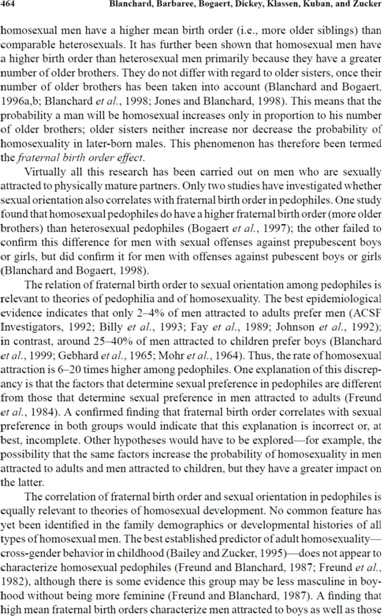
  • A recent study published in the Archives of Sexual Behavior found that "The best epidemiological evidence indicates that only 2 - 4% of men attracted to adults prefer men. In contrast, around 25 - 40% of men attracted to children prefer boys. Thus, the rate of homosexual attraction is 6-20 times higher among pedophiles." [8]

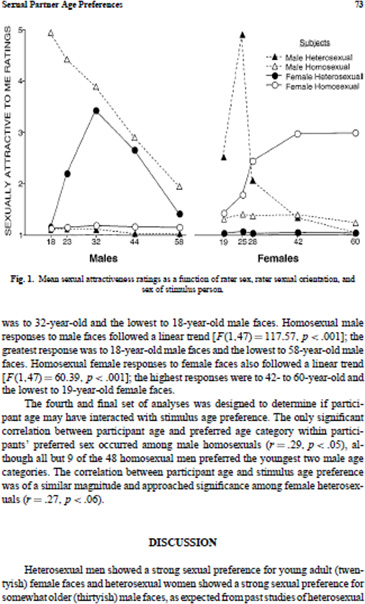
  • Another recent study in the Archives of Sexual Behavior found that "... all but 9 of the 48 homosexual men preferred the youngest two male age categories." These age categories were fifteen and twenty years old. [9]

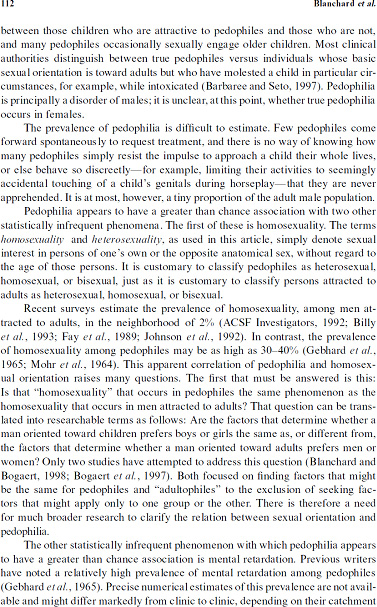
  • A third study in the Archives of Sexual Behavior found that "Pedophilia appears to have a greater than chance association with two other statistically infrequent phenomena. The first of these is homosexuality ... Recent surveys estimate the prevalence of homosexuality, among men attracted to adults, in the neighborhood of 2%. In contrast, the prevalence of homosexuality among pedophiles may be as high as 30 - 40%." [10]

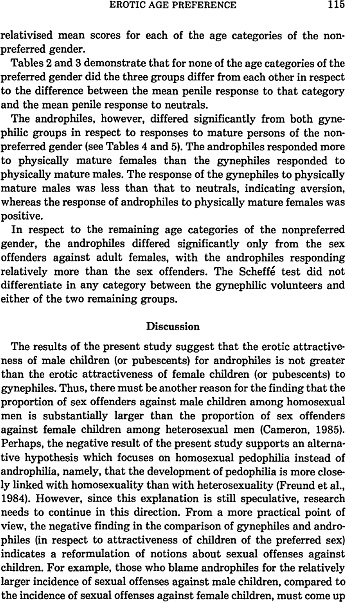
  • A study in the Journal of Sex Research noted that "... the proportion of sex offenders against male children among homosexual men is substantially larger than the proportion of sex offenders against female children among heterosexual men ... the development of pedophilia is more closely linked with homosexuality than with heterosexuality." [11]

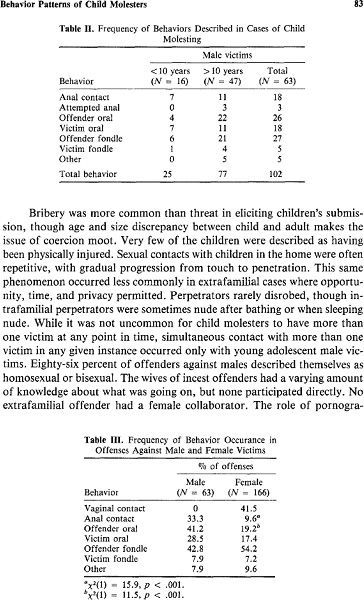
  • A study of 229 convicted child molesters published in the Archives of Sexual Behavior found that "eighty-six percent of [sexual] offenders against males described themselves as homosexual or bisexual." [12]

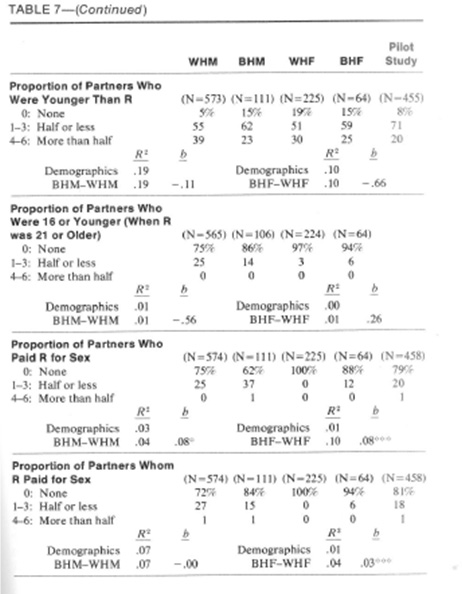
  • A study by The Institute for Sex Research, which was founded by Alfred Kinsey, determined that 25% of white homosexual men have had sex with boys sixteen years and younger. [13]

There are occasional desultory attempts to deny or obscure the fact that a disproportionately high percentage of active homosexuals sexually molest children. These studies are invariably afflicted with one or more fatal flaws.

A typical example, oft quoted by "gay rights" activists, is the July 1994 Pediatrics article by Jenny, Roesler and Poyer that says "Using the data from our study, the 95% confidence limits of the risk children would identify recognizably homosexual adults as the potential abuser, are from 0% to 3.1%. These limits are within current estimates of the prevalence of homosexuality in the general community." [14]

The fatal flaw of this study is that it examined sexually abused children with a mean age of just 6.1 years. Children this young are usually targets of true pedophiles, those persons with no sexual attraction to adults of either sex. By contrast, homosexual pedophiles are usually classified as "ephebophiles," persons sexually attracted to pubescent or post pubescent children.

Definitions and Calculations

The John Jay study on the sexual abuse crisis in the Catholic Church in the United States defines "pedophiles" as people who "exhibit recurrent, intense, sexually arousing fantasies, urges or behaviors related to sexual contact with a prepubescent child over a period of at least six months duration." [15]

When people speak of the current crisis being a problem involving "pedophile priests," they are addressing only a small portion of the situation. According to the John Jay study, most of the sexually offending priests are not true pedophiles. They are in fact "ephebophiles," who "exhibit these same fantasies, urges or behaviors towards post pubescent youths." [16] Generally, the John Jay study recognized that pedophilia can be defined as the sexual molestation of children aged ten and younger. The National Review Board study defines "ephebophilia" as "homosexual attraction to adolescent males," a definition that certainly is validated by the quotes of "gay rights" activists later in this article. [17]

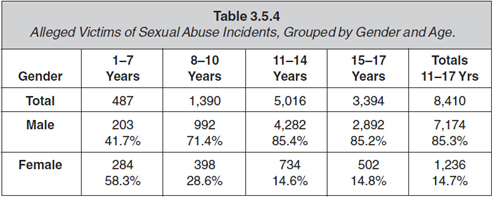
Table 3.5.4 of the John Jay Study is reproduced below. It clearly demonstrates that, as the age of the victims rises, the percentage of victims decisively shifts from primarily female to overwhelmingly male.


The results shown in Table 3.5.4 stand in stark contrast to United States Department of Health and Human Services statistics, which show that male on male child sexual abuse in the USA comprises only 14.4% of all sexual abuse committed by males. In other words, in the general population of males who sexually abuse minors, only one in seven molest boys. In the population of priests who sexually abuse minors, six in seven molest boys. [18]

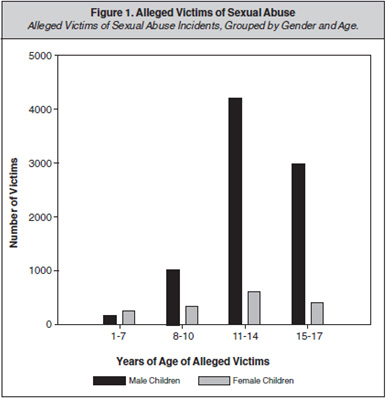
Figure 1 graphically depicts Table 3.5.4, and shows the numbers of alleged victims of sexual abuse incidents grouped by gender and age. One can clearly see that the percentage of victims is overwhelmingly male.


Many experts have claimed that there is a much higher percentage of homosexuals in the priesthood than there is in the general population. Let us assume for a moment that the concentration of male homosexuals in the priesthood is four times greater than it is in the general population — about ten percent. [19]

If we assume that this number is correct, using the figures given in Table 3.5.4, we find that a homosexual priest is

(85.3%/10.0%)/(14.7%/90.0%) = 52

times more likely to molest a child than a heterosexual priest.

If we use the more reasonable assumption that five percent of all priests are homosexual (still about twice the average in the general population), we see that a homosexual priest is

(85.3%/5.0%)/(14.7%/95.0%) = 110

times more likely to molest a child than a heterosexual priest.

It is logical that homosexuals who sexually desire young children deliberately seek employment that will bring them into proximity with the greatest number of children possible. The most "promising" jobs of this nature include clergymen working in youth ministries, Boy Scout leaders and schoolteachers.

This is primarily why homosexual teachers have been involved in a hugely disproportionate number of all recorded cases of teacher/pupil sex. A nationwide survey of school principals showed that they received 13 times as many complaints about homosexuals sexually molesting students than they did about heterosexuals molesting students. [20]

Other studies have shown that homosexual teachers are from 90 to 100 times more likely to molest students than heterosexual teachers. [21]

Supporting Quotes by Homosexual Activists

As further evidence of the strong connection between active homosexuality and child molestation, many homosexual leaders have openly admitted that there is a natural link between a homosexual orientation and child sexual abuse.

Many "gay" organizations and leaders not only admit to, but support, the sexual abuse of children by homosexuals.

An editorial in the San Francisco Sentinel, a member of the National Lesbian & Gay Journalist's Association, claimed that

    The love between men and boys is at the foundation of homosexuality. For the gay community to imply that boy love is not homosexual love is ridiculous. We must not be seduced into believing misinformation from the press and the government. Child molesting does occur, but there are also positive sexual relations. And we need to support the men and the boys in those relationships. [22]
The notorious North American Man Boy Love Association (NAMBLA), one of several major organized pederast groups, always has a drawing or a photo of a pre teen boy on the cover of its NAMBLA Bulletin, as well as many other such depictions within each issue.

Pedophile Philip Hutchinson's poem entitled "Choirboy" is entirely typical of the fare found in the Bulletin;

    You look like a cherub, but you're worldly wise.
    You'd love to have me think you're newly born,
    but I can spot the twinkle in your eyes;
    you know damned well how much you turn me on.
    Between us, you're the satyr — I'm the saint,
    so shed your sacred robe and bare your skin,
    surrender to my touch without restraint,
    and later, put your halo on again. [23]
One of NAMBLA's flyers says that:

    There is no age at which a person becomes capable of consenting to sex. The age of sexual consent is just one of many ways in which adults impose their system of control on children ... Amazing as it may seem in this child hating and homophobic society, boy lovers find boys attractive and like their spontaneity and openness. [24]
Pederast and NAMBLA member David Thorstad has said that "I think that pederasty should be given the stamp of approval. I think it's true that boy lovers are much better for children than the parents are ..." [25]

NAMBLA is by no means on the fringe of the "gay rights" movement. For years, it was a member in good standing of the International Lesbian and Gay Association (ILGA), and was only jettisoned by ILGA when the parent organization applied for United Nations consultative status in 1993. Years earlier, the ILGA itself had resolved that "Young people have the right to sexual and social self determination and that age of consent laws often operate to oppress and not to protect." [26] Homosexual defenders of NAMBLA declared that "man/boy love is by definition homosexual," that "man/boy lovers are part of the gay movement and central to gay history and culture," part of "the Western homosexual tradition from Socrates to Wilde to Gide," and part of "many non Western homo sexualities from New Guinea and Persia to the Zulu and the Japanese." [27]

In fact, one of NAMBLA's "gay" defenders got right to the point when he said that "Homosexuals denying that it is 'not gay' to be attracted to adolescent boys are just as ludicrous as heterosexuals saying it's 'not heterosexual' to be attracted to adolescent girls." [28]

"Gay" leaders and researchers have recognized and publicized the natural relationship between homosexuality and pederasty [adult male sexual molestation of boys] for decades. NAMBLA and similar groups may be in the forefront of promoting "gay" sex with young boys, but many other prominent homosexuals have transmitted the same message;

  • Larry Kramer, founder of the homosexual group AIDS Coalition to Unleash Power (ACT UP), said that "In those cases where children do have sex with their homosexual elders, I submit that often, very often, the child desires the activity, and perhaps even solicits it, either because of a natural curiosity, or because he or she is homosexual and innately knows it. ... And unlike girls or women forced into rape or traumatized, most gay men have warm memories of their earliest and early sexual encounters; when we share these stories with each other, they are invariably positive ones." [29]

  • Pat Califia, lesbian author and activist, wrote in the "mainstream" homosexual publication The Advocate that "Boy lovers and the lesbians who have young lovers are the only people offering a hand to help young women and men cross the difficult terrain between straight society and the gay community. They are not child molesters. The child abusers are priests, teachers, therapists, cops and parents who force their stale morality onto the young people in their custody. Instead of condemning pedophiles for their involvement with lesbian and gay youth, we should be supporting them." [30]

  • Steve Hanson wrote in the homosexual magazine Bay Area Reporter "Shame on us if our lesbian/gay voices remain silent while our NAMBLA brothers are persecuted once again, and shame on those lesbians and gay men who will raise their voices to condemn NAMBLA, insisting that boy lovers (and presumably the boys they love and who love them) are not part of this thing called the lesbian/gay community." [31]

  • One of the authors of The Big Gay Book said that "Sex between youths and adults is one of the most difficult issues in the gay movement. When does a youngster have the right and the power to make his own sexual decisions? How are laws against intergenerational sex used specifically to target gay men? What are the issues that make the romantic image of the Greek teacher and his student in times of antiquity turn into something ugly and forbidden in the modern age?" [32]

  • Lesbian Gayle Rubin wrote that "The recent career of boy love in the public mind should serve as an alert that the self interests of the feminist and gay movements are linked to simple justice for stigmatized sexual minorities. ... We must not reject all sexual contact between adults and young people as inherently oppressive." [33]

Like the "ten percent" myth, the modern-day concept that adults can legitimately have sex with children originated with the Alfred Kinsey team. Sex educator and Kinsey collaborator Wardell Pomeroy said that "People seem to think that any [sexual] contact between children and adults has a bad effect on the child. I say that this can be a loving and thoughtful, responsible sexual activity." [34]

Interestingly, while the mainstream press and liberal groups systematically pillory the Catholic Church, they entirely ignore the well organized and determined efforts by professional associations to decriminalize and normalize child sexual abuse.

For example, the American Psychiatric Association (APA) recently sponsored a symposium in which participants discussed the removal of pedophilia from an upcoming edition of the group's psychiatric manual of mental disorders. At about the same time, the Archives of Sexual Behavior published a special edition in December 2002 discussing whether pedophilia should remain classified as a mental disorder. [35]

As early as 1988, a leading American psychological journal, Behavior Today, claimed that "Pedophilia may be a sexual orientation rather than a sexual deviation. This raises the question as to whether pedophiles may have rights." [36]

Information Provided by a Diocesan Administrator

It is clear, even without reference to the numerous reports throughout the recent years, that homosexuals have infiltrated the ranks of the clergy to an astonishing degree. In some corners of the Church, such behavior has long been seen as acceptable.

To cite just one recent example, Msgr. Richard Sniezyk, appointed to head the Diocese of Springfield in Massachusetts after its bishop resigned amid sexual abuse allegations, said in an interview that the recent scandal in the Catholic Church stems from a belief among some priests during the 1960s, 1970s, and 1980s that sex with young men was "acceptable;"

    Monsignor Richard S. Sniezyk, 66, the leader of the Springfield Diocese until the Vatican names a bishop to replace Thomas L. Dupre, said that as a seminarian and then a young priest ... he heard of priests who had sex with young men, but "no one thought much about it" because priests didn't recognize how mentally and emotionally damaging their behavior was ... "It was that era of the '60s — most of it took place from the mid '60s to the early' 80s — and the whole atmosphere out there was, it was OK, it was OK to do." [37]
This is not a statement by an anti Catholic or homosexual activist, but rather an admission from none other than the duly appointed shepherd of souls in this Massachusetts diocese.

It is easy to look back on the crisis in the Catholic Church in the United States and place blame on the Vatican, on the bishops, on the seminaries, or even on our society's permissive attitude toward sexuality in general. But much terrible damage has already been done — to the victims, to the Church, and to the souls of many whose faith has been shaken or even destroyed by the scandal.

Our primary responsibilities at this point are not blame and condemnation, but reparation and prevention. We must compensate the victims, and we must reassure them by making certain that there are no more future cases of child sexual molestation by clergy or other Church workers.

Does Pederast Equal "Gay"?

Some researchers assert that just because an activity is homosexual in nature does not mean that the person committing the act is a homosexual. For example, criminologist Margaret Smith said that "The majority of the [clergy] abusive acts were homosexual in nature. That participation in homosexual acts is not the same as sexual identity as a gay man." [38]

This is like saying that someone who steals is not a thief, or that someone who races his car down a crowded city street at 200 kilometers per hour is not a reckless driver.

Men who sexually molest boys may claim not to be homosexual, but this assertion is disingenuous at best and deliberately deceptive at worst.

Many of the studies quoted above show that homosexual men are attracted to young boys. An Archives of Sexual Behavior study compared the sexual age preferences of people who described themselves as heterosexual men, heterosexual women, homosexual men, and lesbians. The results showed that "all but 9 of the 48 homosexual men preferred the youngest two male age categories," which included males as young as age fifteen. [39]

Sometimes homophile groups allege that men who sexually molest boys are generally not sexually attracted to adult males, and therefore should not be considered homosexuals.

Once again, research does not support such a claim. A study of sex offenders against male children in Behavior Research and Therapy found that male pederasts are sexually attracted to "males of all ages." Compared to non offenders, the offenders showed "greater arousal" when viewing slides of nude males as old as twenty four: "As a group, the child molesters responded with moderate sexual arousal ... to the nude males of all ages." [40]

In fact, a large percentage of pedophiles consider themselves to be homosexual. A study of 229 convicted child molesters in the Archives of Sexual Behavior found that "eighty six percent of [sexual] offenders against males described themselves as homosexual or bisexual." [41]

Is Celibacy the Problem?

Many opportunists claim that, if the Catholic Church would simply relax its rules on celibacy, the sexual abuse crisis would be greatly ameliorated.

This assertion simply makes no sense.

Those priests who sexually molest boys have just as much access to adult women as other men. In fact, since priests are admired and respected professionals, we might reasonably say that they have more ready access to women than do other men.

The most certain proof that there is no correlation between celibacy and child molestation comes from the fact that married men commit child sexual abuse at about the same rate as Catholic priests.

There are about 260 reports each year of children under 18 being sexually abused by Protestant clergy, church staff, volunteers or congregation members. By comparison, 4,392 priests (out of 109,000) were accused of sexual abuse during the time period 1950 to 2002, an average of 84 per year. [42]

These numbers are backed up by a comprehensive study by Professor Philip Jenkins of Penn State, which found that between 0.2 percent and 1.7 percent of priests are pedophiles, and 2 to 3 percent of Protestant clergy are pedophiles, a somewhat higher rate. [43]

Since Protestant clergy are free to marry, it is obvious that allowing priests to marry will not solve the problem.

"Born that Way?" So What?

We often hear from the homosexual rights movement that "gays" are "born that way." This may or may not be true, depending on which of the hundreds of conflicting studies we choose to believe. Some experts believe that, in many cases, homosexuality is an acquired condition due to the lack of an effective male role model.

In the most fundamental sense, this point is irrelevant. We are all born with weaknesses, a direct result of our fallen natures.

We can deal with these weaknesses in one of two ways. We can accept them as crosses given to us by God, and we can glorify His Name by struggling to overcome them with the aid of His grace. Or we can simply give in and use the "born that way" excuse, the weak and cowardly road that is a vote of no confidence in God's grace and its ability to save us.

A person can have a genetic predisposition towards alcoholism. Yet our spouses do not accept the "born that way" excuse if we arrive home drunk every night. Kleptomania may indeed also be genetic, yet no court in the world has ever accepted the "born that way" excuse as a defense against shoplifting charges.

Alcoholics and those tempted to steal can be good and holy priests — just so long as they recognize their weaknesses, avoid near occasions of sin, and fight to overcome them on a daily basis with the help of God's grace. Men who are sexually attracted to women or to other men can also become saintly priests — but only if they do not give in to temptation and act out their desires.

A man who is living an active homosexual lifestyle, or who even experiences homosexual tendencies, should never be ordained a priest. [44] The danger to souls and to lives is just too great, as the sexual abuse crisis in the Church has amply demonstrated.

Conclusions

Ephebophilia, or the sexual desire for adolescent boys, has always been a hallmark of homosexuality, as shown by numerous scientific studies, and as admitted by "gay" leaders themselves on many occasions.

Homophile groups are exploiting the current crisis in the Church in order to achieve their goals, a classic strategy of infiltration and subversion. Many of these groups vocally supported "man-boy love" in the 1960s and 1970s. Now the same groups are attacking the Church because pedophile priests followed their advice and became "boy-lovers!"

The primary goal of those attacking the Church is to publicly destroy its moral authority so that people will not heed its teachings that homosexual behavior is sinful, and that homosexual "marriage" is a fraud.

A secondary goal of these groups is to eliminate the requirement for celibacy among priests. However, married Protestant clergy have a larger rate of child sexual molestation as Catholic priests, proving that celibacy has nothing at all to do with pederasty.

In summary, there are many attacking on the Pope specifically and the Roman Catholic Church generally because of the sex abuse crisis. However, these individuals and organizations are not motivated by a desire to enlighten mankind or protect the innocent, since the crisis has already largely subsided, and stringent means have been enacted to prevent the abuse from reoccurring. Rather, the motivation appears to be more one of bigotry and a desire to muzzle and sideline the Church's moral opposition to the "gay rights" movement.

The Author

Brian W. Clowes, Ph.D., is a 1974 graduate of the United States Military Academy at West Point. In 1995 he became the Director of Research and Training for Human Life International. He has written and edited eleven books and over one hundred articles in several fields of discipline. Dr. Clowes, his wife Kathy, and their seven children live in Front Royal, Virginia.


APPENDIX

PAGE IMAGES FROM SELECTED MEDICAL
PUBLICATIONS CITED IN THE TEXT


NOTES:

[1]  Dignity USA Web site, February 6, 2004. This campaign was begun during the United States Conference of Catholic Bishops annual meeting in Washington, D.C., November 10 13, 2002. We should point out that the very existence of a group that supports sexually active "gay priests" is a great source of scandal.

[2]  Rory Carroll. "Vatican Attacked over Cardinal's Claim of Homosexuality and Paedophilia Link." The Guardian, April 13, 2010.

[3]  Laird Wilcox. "The Practice of Ritual Defamation." Editorial Research Service Web site at http://www.lairdwilcox.com. Homophiles will inevitably use these tactics in attempts to discredit this report. Defenders of the Catholic Church must ignore these attacks and emphasize the quotes, statistics and conclusions contained in this work.

[4]  Perhaps the best general article on the bigotry of the "Pope-hunters" is by atheist Brendan O'Neill. "The Pope-Hunters' Pathological Campaign." The Australian, April 15, 2010.

[5]  Hans Küng. "Church in Worst Credibility Crisis since Reformation, Theologian Tells Bishops." The Irish Times, April 16, 2010.

[6]  Dignity USA Web site, February 6, 2004.

[7]  Alfred Kinsey data described in P.H. Gebhard and A.B. Johnson. The Kinsey Data. Saunders Publishing, 1979. Table 443, "Homosexual Sample: Age at First Postpubertal Homosexual Contact," and Table 444, "Homosexual Sample: Age of Partner in First Postpubertal Homosexual Contact." Even though much of Kinsey's research has been thoroughly discredited, his enduring primacy in the field of 'sexology' means that sex educators and others involved in human sexuality study his material intensively, and have therefore been aware of the strong link between homosexuality and pedophilia for more than six decades.

[8]  Ray Blanchard, et al. "Fraternal Birth Order and Sexual Orientation in Pedophiles." Archives of Sexual Behavior, October 2000 [Volume 29, Number 5], pages 463-478, p. 464.

[9]  A. Zebulon, Z.A. Silverthorne and Vernon L. Quinsey. "Sexual Partner Age Preferences of Homosexual and Heterosexual Men and Women." Archives of Sexual Behavior, February 2000 [Volume 29, Number 1], pages 67-76, p. 73.

[10]  Ray Blanchard, et. al. "Pedophiles: Mental Retardation, Maternal Age, and Sexual Orientation." Archives of Sexual Behavior, April 1999 [Volume 28, Number 2], pages 111-127, p. 112.

[11]  Kurt Freund, Robin Watson and Douglas Rienzo. "Heterosexuality, Homosexuality, and Erotic Age Preference." Journal of Sex Research, February 1989 [Volume 26, Number 1], pages 107-117, p. 115.

[12]  W.D. Erickson, et al. "Behavior Patterns of Child Molesters." Archives of Sexual Behavior, February 1988 [Volume 17, Number 1], pages 77-86, p. 83.

[13]  Alan P. Bell, et. al., Institute for Sex Research. Homosexualities: A Study of Diversity Among Men and Women [New York City: Simon and Schuster], 1978. Appendix C, Table 7, "Sexual Partnerships," page 311.

[14]  C. Jenny, T.A. Roesler, and K.L. Poyer. "Are Children at Risk for Sexual Abuse by Homosexuals?" Pediatrics, July 1994 [Volume 94, Number 1], pages 41-44.

[15]  John Jay College of Criminal Justice. The Nature and Scope of the Problem of Sexual Abuse of Minors by Catholic Priests and Deacons in the United States. April 2004, Section 3.1, "Introduction to the Problem of Child Sexual Abuse by Adult Men."

[16]  Ibid.

[17]  National Review Board. A Report on the Crisis in the Catholic Church in the United States. February 27, 2004, page 27, footnote 15.

[18]  United States Department of Health & Human Services, Administration for Children and Families, Administration on Children, Youth and Families, Children's Bureau. Child Maltreatment [annual reports, 1995 to 2008].

[19]  One of the "articles of faith" of the "gay rights" movement is that ten percent of any population is homosexual. In fact, the numbers are much smaller. There have been a number of major studies gauging the percentage of homosexuals in the general population. The aggregated results of these studies surveyed more than 218,000 men in several countries and show that 2.6 percent of the male population has ever had a homosexual experience in their lives [for a list of these studies, see Brian W. Clowes and David L. Sonnier. "Child Molestation by Homosexuals and Heterosexuals." Homiletic & Pastoral Review, May 2005, pages 44-54].

[20]  J. Dressler. "Gay Teachers: A Disesteemed Minority in an Overly Esteemed Profession." Rutgers/Camden Law Journal, 1978, 9(3), pages 399-445.

[21]  Ibid.

[22]  Point of View. "No Place for Homo Homophobia." San Francisco Sentinel, March 26, 1992.

[23]  Pedophile Philip Hutchinson's poem entitled "Choirboy." NAMBLA Bulletin, January February 1984, page 14.

[24]  NAMBLA flyer, quoted in Shirley J. O'Brien. "The Child Molester: Porn Plays a Major Role in Life." National Federation for Decency Journal, May/June 1987, pages 9-11.

[25]  David Thorstad, quoted in Joseph Sobran. "The Moderate Radical." Human Life Review, Summer 1983, pages 59-60. "Pederasty" is generally defined as the sexual molestation of a boy by an adult male not in his immediate family.

[26]  Wikipedia entry on NAMBLA, April 14, 2010.

[27]  Joshua Gamson. "Messages of Exclusion: Gender, Movements, and Symbolic Boundaries." Gender and Society April 1997 [Volume 11, Number 2], pages 178 199.

[28]  Ibid.

[29]  Larry Kramer, in Reports from the Holocaust [New York City: St. Martin's Press], 1991.

[30]  Pat Califia, in The Advocate, October 1980.

[31]  Steve Hanson. "Shame on Us." B.A.R. (Bay Area Reporter), January 23, 1992.

[32]  John Preston, quoted in The Big Gay Book: A Man's Survival Guide for the '90s [New York City: Plume], 1991.

[33]  Gayle Rubin, quoted in Leaping Lesbian, February, 1978. This article originally appeared in an article entitled "Sexual Politics, the New Right, and the Sexual Fringe" in The Age Taboo [Alyson Press], 1981, pages 108-115.

[34]  Wardell Pomeroy, quoted in Michael Ebert. "Pedophilia Steps Into the Daylight." Focus on the Family Citizen, November 16, 1992, pages 6-8.

[35]  Lawrence Morahan. "Psychiatric Association Debates Lifting Pedophilia Taboo." CNSNews.com, June 11, 2003; Archives of Sexual Behavior article discussed in Linda Ames Nicolosi. "International Academy of Sex Research Joins the Debate: Is Pedophilia a Mental Disorder?" NARTH, June 26, 2003.

[36]  Behavior Today, December 5, 1988, page 5.

[37]  John M. McElhenny, "Monsignor Says Harm of Abuse Wasn't Recognized." Boston Globe, February 23, 2004.

[38]  Jeremy Schulman. "Expert: Donohue's Claim that Most Abusive Priests are Gay is "Unwarranted." Media Matters for America Web site, April 2, 2010.

[39]  Zebulon, Z.A. Silverthorne and Vernon L. Quinsey. "Sexual Partner Age Preferences of Homosexual and Heterosexual Men and Women." Archives of Sexual Behavior, February 2000 [Volume 29, Number 1], pages 67-76.

[40]  W.L. Marshall, H.E. Barbaree, and Jennifer Butt. "Sexual Offenders Against Male Children: Sexual Preferences." Behavior Research and Therapy, 26 (1988): 383.

[41]  W.D. Erickson, et al. "Behavior Patterns of Child Molesters." Archives of Sexual Behavior, February 1986 [Volume 17, Number 1], pages 77-86, p. 83.

[42]  Rose French. "260 Reports of Abuse Yearly in Protestant Churches." Chicago Sun-Times, June 15, 2007. Also see the John Jay study for statistics on accused Catholic priests.

[43]  Philip Jenkins. Pedophiles and Priests: Anatomy of a Contemporary Crisis [New York City: Oxford University Press], 1996, pages 50 and 81.

[44]  Congregation for Catholic Education. Instruction "Concerning the Criteria for the Discernment of Vocation with Regard to Persons with Homosexual Tendencies in the View of Their Admission to the Seminary and to Holy Orders," November 4, 2005.